

CTV Performance Marketing Measurement Strategy Guide
Understanding CTV performance marketing measurement is crucial for advertisers navigating the evolving landscape of digital advertising. Connected TV (CTV) offers a powerful channel to reach engaged audiences, but effectively tracking and optimizing campaign performance requires sophisticated strategies. This guide delves into the essential methods and tools for accurately measuring the impact of your CTV ad spend, ensuring you maximize return on investment. We will explore how to attribute conversions, track user journeys, and leverage data to drive better outcomes in your streaming TV campaigns.
Understanding CTV Performance Marketing Measurement: Why It Matters
CTV performance marketing measurement refers to the process of tracking, analyzing, and optimizing the effectiveness of advertising campaigns delivered through connected TV devices, focusing on measurable outcomes like website visits, app downloads, or purchases. It is vital for advertisers because it moves beyond traditional brand awareness metrics, allowing for direct correlation between ad exposure and consumer action. This data-driven approach ensures marketing budgets are allocated efficiently, driving tangible business growth. Without robust measurement, marketers risk misinterpreting campaign success and making suboptimal investment decisions in the rapidly expanding CTV ecosystem.

Defining Performance in the Connected TV Landscape
Performance in CTV extends beyond traditional reach and frequency to include direct response actions. Advertisers aim to drive specific user behaviors following ad exposure. This includes website visits, lead form submissions, app installs, or even direct purchases. Defining clear performance goals is the first step in any effective measurement strategy. These goals should align with broader business objectives.
The Evolution from Linear TV to Measurable CTV
Linear TV historically focused on broad demographic reach and brand building, with measurement often limited to ratings and GRPs. CTV, however, brings the precision and measurability of digital advertising to the big screen. It allows for audience targeting, ad personalization, and, most importantly, detailed performance tracking. This shift enables marketers to treat CTV as a direct response channel, similar to search or social media. The ability to connect ad views to downstream actions transforms CTV into a powerful performance driver.
Key Benefits of Robust CTV Performance Tracking
Implementing strong CTV performance marketing measurement offers several significant benefits. It provides clear insights into which campaigns and creatives are most effective. This allows for real-time optimization and improved campaign efficiency. Better measurement also justifies increased investment in CTV by demonstrating clear ROI. It helps in understanding the full customer journey, including the role CTV plays in influencing conversions. Ultimately, it leads to more strategic and profitable advertising efforts.
How Does Connected TV Attribution Work for Performance Campaigns?
Connected TV attribution identifies which specific CTV ad exposures contributed to a desired user action, such as a website visit or a purchase. It works by linking ad impressions on CTV devices to subsequent conversions that occur on other devices or platforms. This process is complex due to the multi-device nature of CTV viewing and the absence of direct click-throughs. Marketers use various models and technologies to bridge this gap, providing a clearer picture of CTV’s impact on the conversion funnel. For more insights, check out our guide on Digital Marketing Services.
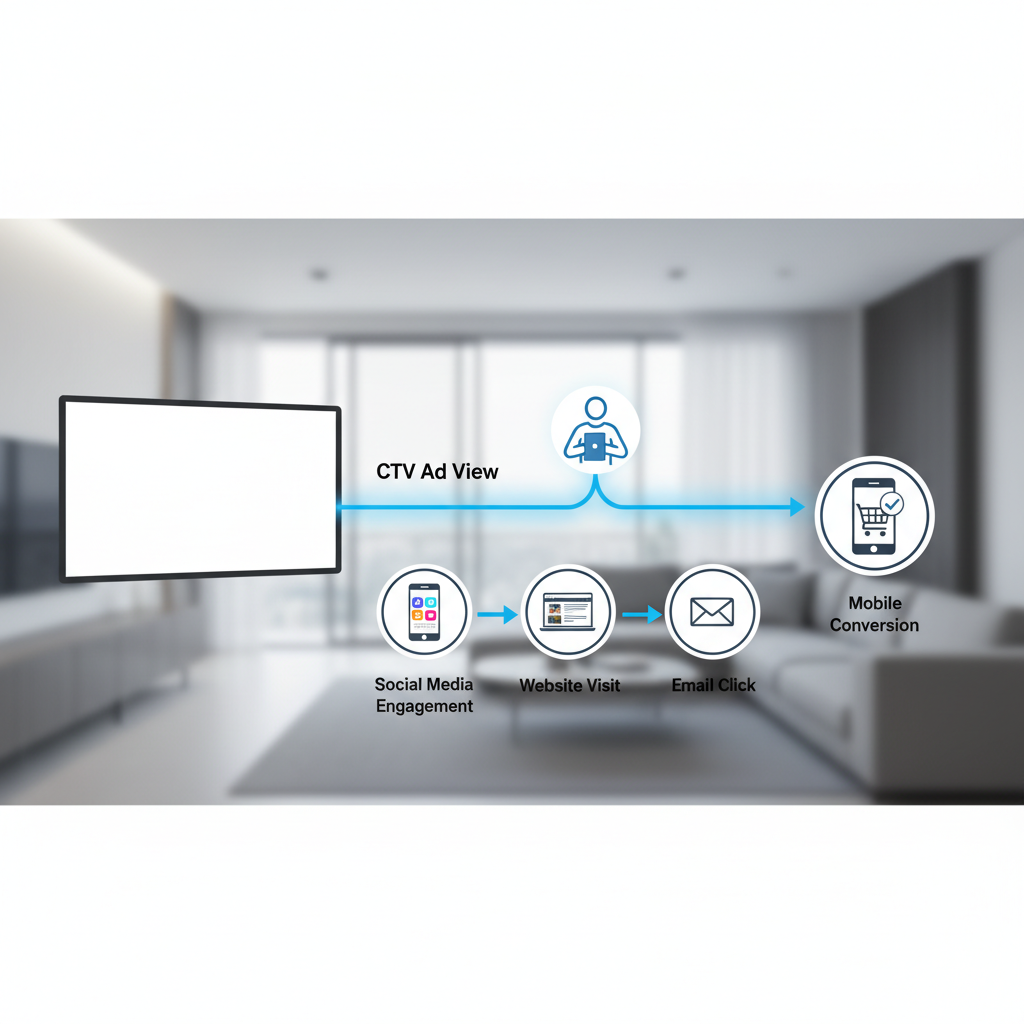
Understanding Cross-Device Attribution in CTV
Cross-device attribution is fundamental to CTV performance measurement. A user might see an ad on their smart TV, then pick up their smartphone to search for the product. Traditional last-click attribution models often fail to credit the initial CTV exposure. Advanced attribution solutions use identity graphs and probabilistic matching to connect these disparate touchpoints. This allows marketers to understand the full user journey across devices. It provides a more accurate view of CTV’s influence.
Common Attribution Models for Streaming TV Performance Ads
Several attribution models can be applied to streaming TV performance ads, each with its own strengths and weaknesses.
* Last-Touch Attribution: Credits the last touchpoint before conversion. Simple, but often undervalues earlier CTV exposure.
* First-Touch Attribution: Credits the very first touchpoint. Useful for understanding initial awareness generated by CTV.
* Linear Attribution: Distributes credit equally across all touchpoints. Provides a balanced view.
* Time Decay Attribution: Gives more credit to touchpoints closer to the conversion. Reflects the recency effect.
* U-Shaped or W-Shaped Attribution: Assigns more weight to first and last touches, with some credit for mid-funnel interactions.
* Data-Driven Attribution: Uses machine learning to assign credit based on actual campaign data. This is often the most sophisticated and accurate.
Choosing the right model depends on campaign goals and data availability. Many advertisers use a combination of models to gain comprehensive insights.
Challenges and Solutions in Connected TV Attribution
Connected TV attribution faces unique challenges. The lack of cookies on CTV devices makes direct tracking difficult. Privacy regulations also limit data collection. Solutions involve leveraging household IP addresses for probabilistic matching. Device graphs from third-party providers also play a crucial role. Integrating data from ad platforms, CTV publishers, and CRM systems helps create a unified view. Furthermore, incrementality testing can isolate CTV’s true impact by comparing exposed groups to control groups. This helps to validate attribution models.
Essential Metrics for Streaming TV Performance Ads: What to Track
Tracking the right metrics is paramount for evaluating the success of streaming TV performance ads. Beyond traditional reach and frequency, performance marketers must focus on actionable data points that directly correlate with business objectives. Key metrics include website visits, app installs, lead generation, and ultimately, return on ad spend (ROAS). These metrics provide a clear picture of how CTV campaigns are driving user engagement and conversions, allowing for data-driven optimization. For more insights, check out our guide on Digital Marketing Services.
Key Performance Indicators (KPIs) for CTV Campaigns
Successful CTV campaigns are measured by a range of KPIs that go beyond simple ad views.
* Impression Volume and Frequency: While foundational, these indicate reach and exposure.
* Video Completion Rate (VCR): Shows how engaging your creative is, as a higher VCR often correlates with better performance.
* Website Visits/Traffic: Measures direct response to the ad, indicating interest.
* App Installs/Downloads: A crucial metric for app-focused advertisers.
* Lead Generation: Number of form submissions or inquiries driven by CTV.
* Conversion Rate: The percentage of viewers who complete a desired action.
* Cost Per Acquisition (CPA): The cost associated with each conversion.
* Return on Ad Spend (ROAS): The revenue generated for every dollar spent on CTV ads. This is often the ultimate measure of performance.
Leveraging Data Sources for Comprehensive Measurement
Effective CTV ad measurement guide strategies rely on integrating data from multiple sources.
* Ad Server Data: Provides impression, completion, and basic interaction metrics.
* CTV Platform Analytics: Offers insights into audience demographics, viewing habits, and ad delivery.
* Website Analytics (e.g., Google Analytics): Tracks post-view behavior, including site visits, page views, and conversions.
* CRM Systems: Links ad exposure to customer data and sales outcomes.
* Mobile Measurement Partners (MMPs): Essential for tracking app installs and in-app events.
* Third-Party Measurement Solutions: Specialized tools that offer advanced attribution and incrementality testing.
Combining these data sources creates a holistic view of campaign performance. This allows for more accurate attribution and optimization.
Analyzing Post-View and View-Through Conversions
Post-view conversions are actions taken by users who saw a CTV ad but did not click on it (since CTV is largely non-clickable). View-through conversions specifically refer to conversions that occur within a defined look-back window after an ad impression. These are critical for understanding the true impact of CTV, as direct clicks are rare. Marketers must establish clear look-back windows (e.g., 7, 14, or 30 days) to accurately attribute these conversions. This analysis helps demonstrate CTV’s influence on the entire customer journey, even without direct interaction.
Implementing Effective CTV Conversion Tracking: Strategies and Tools
Implementing effective CTV conversion tracking involves a strategic combination of technology and methodology to accurately link ad exposures on connected TV devices to desired actions. This requires setting up robust tracking mechanisms across various platforms and devices. It also means leveraging specialized tools designed to overcome the unique challenges of the CTV environment. The goal is to gain clear insights into which CTV campaigns are driving the most valuable conversions.
Setting Up Cross-Platform Conversion Tracking
Cross-platform tracking is essential for CTV. Since conversions often happen on a different device than the ad view, marketers must employ solutions that can bridge this gap. This often involves pixel-based tracking on websites and apps, combined with server-side integrations. Universal tracking tags can be deployed across all digital properties. These tags collect data on user behavior post-ad exposure. Ensuring proper implementation and consistent data flow across all platforms is critical for accurate measurement.
Tools and Technologies for CTV Conversion Tracking
A variety of tools facilitate robust CTV conversion tracking.
* Ad Platforms (e.g., Google Ads, The Trade Desk): Offer their own conversion tracking pixels and reporting.
* Website Analytics Platforms (e.g., Google Analytics 4): Can be configured to track conversions and integrate with ad platforms.
* Mobile Measurement Partners (MMPs): Essential for app advertisers, providing detailed install and in-app event tracking.
* Demand-Side Platforms (DSPs): Often have built-in measurement capabilities and integrations with third-party verification.
* Data Management Platforms (DMPs) and Customer Data Platforms (CDPs): Help unify audience data and link identities across devices.
* Attribution Platforms: Specialized tools that provide advanced attribution modeling and reporting.
Choosing the right combination of tools depends on the advertiser’s specific needs and tech stack. Utilizing a comprehensive set of tools enhances the accuracy and depth of tracking. For those looking to optimize their entire digital marketing ecosystem, exploring comprehensive Digital Marketing Services can provide a holistic approach to integrating these technologies and strategies for maximum impact.
Best Practices for Data Collection and Integration
To ensure accurate CTV conversion tracking, follow these best practices:
1. Standardize Naming Conventions: Use consistent naming for campaigns, ad sets, and creatives across all platforms. This simplifies data aggregation and analysis.
2. Implement Server-Side Tracking: Where possible, use server-to-server (S2S) integrations for more reliable data transfer and reduced reliance on client-side pixels.
3. Leverage Identity Resolution: Partner with providers who can help resolve user identities across devices using deterministic or probabilistic matching.
4. Regularly Audit Tracking Setup: Periodically review your tracking pixels, tags, and integrations to ensure they are firing correctly and collecting accurate data.
5. Maintain Data Privacy Compliance: Ensure all data collection and usage adheres to relevant privacy regulations (e.g., GDPR, CCPA).
6. Integrate Data Warehouses: Consolidate data from all sources into a central data warehouse for unified analysis and reporting.
| Tracking Method | Pros | Cons | Best Use Case |
|---|---|---|---|
| Pixel-Based Tracking | Easy to implement on websites; widely supported. | Reliance on cookies (less effective on CTV); client-side limitations. | Website conversions, basic event tracking. |
| Server-Side Tracking (S2S) | More reliable; less susceptible to ad blockers; enhanced privacy. | Requires technical setup; can be more complex. | Sensitive data, critical conversions, cross-device. |
| Mobile Measurement Partners (MMPs) | Specialized for app installs and in-app events; robust attribution. | Primarily for mobile apps; adds another vendor. | App-centric campaigns, detailed mobile attribution. |
| Identity Resolution Providers | Connects user identities across devices; improves cross-device attribution. | Can be costly; relies on third-party data. | Complex cross-device journeys, holistic customer view. |
Overcoming Challenges in CTV Ad Measurement for Optimal Results
Measuring performance in CTV presents unique hurdles that demand innovative solutions. The primary challenges include the fragmented nature of the CTV ecosystem, the lack of traditional cookies for tracking, and the difficulty in accurately attributing cross-device conversions. Overcoming these obstacles requires a strategic approach, leveraging advanced technologies, and adopting a flexible mindset to ensure accurate and actionable insights from your CTV performance marketing measurement.
Addressing Data Fragmentation and Silos
The CTV landscape is highly fragmented, with numerous publishers, platforms, and devices. This often leads to data silos, where performance data resides in separate systems. Integrating these disparate data sources is crucial for a holistic view. Solutions include using data clean rooms, implementing universal IDs where available, and building robust data warehouses. These allow marketers to consolidate data from various CTV platforms, ad servers, and analytics tools. A unified data strategy is key to breaking down these silos.
Navigating Privacy Concerns and Cookieless Tracking
Privacy regulations like GDPR and CCPA, coupled with the cookieless nature of CTV, significantly impact tracking capabilities. Advertisers must find privacy-compliant alternatives to traditional cookie-based measurement. This involves leveraging probabilistic and deterministic identity graphs, which match users across devices based on anonymized data points. Contextual targeting and audience segments built on first-party data are also becoming increasingly important. Focusing on aggregated, privacy-safe data insights ensures compliance while still enabling effective measurement.
Measuring Incrementality and True ROI for CTV
A common challenge is proving that CTV campaigns genuinely drive incremental conversions, rather than simply reaching users who would have converted anyway. Incrementality testing is vital for this. This involves setting up controlled experiments where a segment of the audience is exposed to CTV ads, while a control group is not. By comparing the conversion rates of these groups, marketers can isolate the true incremental lift provided by CTV. This approach provides a more accurate picture of CTV performance marketing measurement and its real ROI, moving beyond simple attributed conversions.
Developing a Comprehensive CTV Ad Measurement Guide: Best Practices
Developing a comprehensive CTV ad measurement guide is essential for any advertiser looking to maximize the effectiveness of their connected TV campaigns. Such a guide provides a structured framework for consistently tracking, analyzing, and optimizing performance across all CTV initiatives. It encompasses setting clear objectives, selecting appropriate metrics, implementing advanced attribution models, and continuously refining strategies based on data-driven insights. This ensures that every dollar spent on CTV ads contributes to tangible business growth.
Establishing Clear Objectives and Benchmarks
The foundation of any effective measurement strategy is clearly defined objectives. Before launching any CTV campaign, marketers must determine what success looks like. Are you aiming for brand awareness, website traffic, app installs, or direct sales? Each objective will dictate different KPIs and measurement approaches. Establish realistic benchmarks based on historical data, industry averages, and competitor performance. These benchmarks provide a standard against which to evaluate campaign success.
Integrating CTV Measurement into the Broader Marketing Mix
CTV does not operate in a vacuum; it is part of a larger marketing ecosystem. A comprehensive CTV ad measurement guide integrates CTV data with insights from other channels like search, social, and display. This allows for a holistic understanding of the customer journey and the synergistic effects of different channels. Multi-touch attribution models become particularly valuable here, helping to allocate credit appropriately across all touchpoints. Understanding CTV’s role in the overall marketing mix helps optimize budget allocation across channels.
Continuous Optimization and Iteration Based on Data
Measurement is not a one-time task; it is an ongoing process of optimization and iteration. Regularly analyze your CTV performance data to identify trends, opportunities, and areas for improvement. A/B test different creatives, targeting parameters, and ad formats to see what resonates best with your audience. Use insights from your CTV conversion tracking to refine your strategies. This continuous feedback loop ensures that your CTV campaigns are always evolving and improving, driving better results over time. Stay agile and adapt to new data and market changes.
What is the primary goal of CTV performance marketing measurement?
The primary goal is to determine the direct impact of CTV ad spend on measurable business outcomes, such as website visits, app installs, or purchases. It helps advertisers optimize their budgets and prove the return on investment (ROI) of their CTV campaigns.
How does connected TV attribution differ from traditional digital attribution?
Connected TV attribution is more complex due to the multi-device viewing environment and the lack of direct click-throughs. It relies heavily on cross-device identity resolution and post-view conversion tracking, unlike traditional digital attribution which often uses cookies and direct clicks.
Why is cross-device tracking important for streaming TV performance ads?
Cross-device tracking is crucial because users often see an ad on their CTV and then convert on another device, like a smartphone or computer. Without it, marketers cannot accurately link the initial CTV exposure to the final conversion, leading to underestimation of CTV’s impact.
What are some common challenges in CTV ad measurement?
Common challenges include data fragmentation across platforms, the absence of traditional cookies for tracking, privacy regulations limiting data collection, and accurately measuring incremental lift. Overcoming these requires advanced attribution models and data integration strategies.
Can CTV conversion tracking be done without cookies?
Yes, CTV conversion tracking can be done without cookies. It typically leverages household IP addresses, deterministic and probabilistic identity graphs, and server-to-server integrations. These methods help connect ad exposures to conversions in a privacy-compliant manner.
What is a good look-back window for CTV attribution?
A good look-back window for CTV attribution varies but commonly ranges from 7 to 30 days. The ideal window depends on the product’s sales cycle and consumer behavior. Shorter windows might miss some delayed conversions, while longer windows risk over-attributing.
The landscape of CTV advertising offers unparalleled opportunities for reaching engaged audiences with highly targeted messages. However, unlocking its full potential hinges on sophisticated CTV performance marketing measurement. By moving beyond traditional metrics and embracing advanced attribution, cross-device tracking, and continuous optimization, advertisers can gain profound insights into their campaigns.
Key takeaways for effective CTV measurement include:
* Define Clear Objectives: Always start with specific, measurable goals for your CTV campaigns.
* Embrace Cross-Device Attribution: Understand the full customer journey by linking CTV ad views to conversions on other devices.
* Leverage Diverse Data Sources: Integrate data from ad platforms, analytics tools, and CRM systems for a holistic view.
* Prioritize Privacy-Compliant Tracking: Adapt to a cookieless environment using identity graphs and server-side solutions.
* Focus on Incrementality: Prove the true value of CTV by measuring the incremental lift it provides.
* Iterate and Optimize: Continuously analyze performance data to refine strategies and improve ROI.
By implementing these strategies, marketers can transform their CTV campaigns into powerful drivers of performance, ensuring every advertising dollar is spent effectively. Start refining your CTV ad measurement guide today to unlock better results.