

Mastering Query Fan-Out SEO for Modern Search Visibility
Query fan-out SEO is a sophisticated strategy that involves creating comprehensive content designed to rank for a broad spectrum of related search queries stemming from a core topic. This approach moves beyond targeting a single keyword, instead aiming to capture user intent across various stages of the buyer journey and related informational needs. In today’s evolving search landscape, particularly with the rise of AI-powered search, understanding and implementing query fan-out is crucial for achieving superior organic visibility and authority. It ensures your content provides holistic answers, satisfying diverse user queries that Google’s advanced algorithms, including Google AI Mode query fan-out, are designed to understand and serve.
What is Query Fan-Out SEO and Why Does It Matter for AI Search?
Query fan-out SEO is a content strategy focused on expanding your reach by addressing a wide array of related search queries that stem from a central theme or user intent. It involves developing content that comprehensively covers a topic, anticipating and answering not just the primary keyword query, but also numerous long-tail, semantic, and related questions users might ask. This holistic approach is vital in the era of AI-driven search, where algorithms prioritize depth and breadth of information to satisfy complex user needs. For more insights, check out our guide on Digital Marketing Services.

The importance of query fan-out SEO has grown significantly with the advent of AI in search. Modern search engines, powered by sophisticated AI models, are adept at understanding natural language and the underlying intent behind queries. They no longer rely solely on exact keyword matches. Instead, they seek to provide the most complete and authoritative answer, often pulling information from various sections of a single, well-structured piece of content. This means a single article can rank for dozens, even hundreds, of related queries if it demonstrates deep semantic coverage. Neglecting this strategy can lead to missed opportunities for visibility, especially as search results increasingly feature AI-generated summaries and answers that draw from comprehensive sources.
How Query Fan-Out Differs from Traditional Keyword Targeting
Traditional keyword targeting often focuses on optimizing individual pages for specific keywords, sometimes leading to fragmented content. Query fan-out, conversely, emphasizes creating robust content hubs or pillar pages that serve as definitive resources for an entire topic cluster. This shift allows for greater authority building and a more natural user experience. It’s about answering the question behind the query, not just matching words.
The Role of Semantic Search in Query Fan-Out
Semantic search is the backbone of effective query fan-out. It allows search engines to understand the meaning and context of words, not just their literal form. By creating content that semantically covers a topic, you naturally address a broader range of related queries. This means using synonyms, related concepts, and answering implied questions, all of which contribute to a richer, more AI-friendly content experience.
How Google AI Mode Query Fan-Out Impacts Content Strategy?
Google AI Mode query fan-out fundamentally reshapes how content should be planned and executed, moving away from siloed keyword optimization towards a more interconnected, intent-based approach. Google’s AI, including models like MUM and RankBrain, excels at understanding complex queries and connecting them to a vast network of related information. This capability means that a single piece of content can now satisfy a wider array of user intents, provided it is structured to facilitate this “fanning out” of answers. Instead of creating separate articles for “best running shoes for flat feet” and “running shoe recommendations for overpronation,” a comprehensive guide on “choosing running shoes for specific foot types” can address both, along with many other related queries.
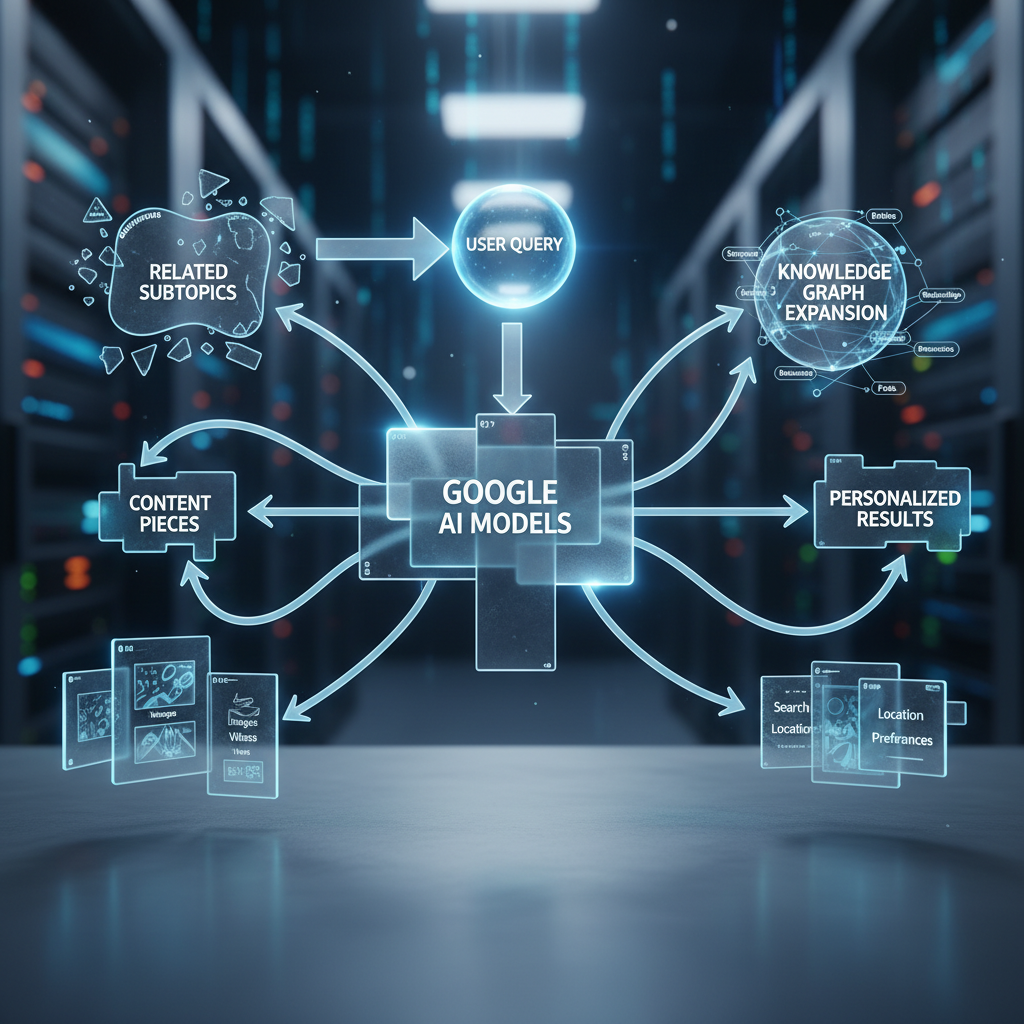
The impact on content strategy is profound: it necessitates a move towards creating authoritative, long-form content that serves as a central resource. This content must anticipate not just direct questions, but also follow-up questions, related concepts, and different angles of the same topic. For example, an article about “how to start a blog” might also need to cover “choosing a niche,” “blogging platforms,” “content ideas for beginners,” and “monetization strategies,” as these are all natural extensions of the initial query. This approach allows your content to be a primary source for Google AI Mode query fan-out, enabling it to appear for diverse search intents.
Adapting to AI’s Understanding of User Intent
Google’s AI is increasingly sophisticated at discerning the true intent behind a user’s search, even when the query is vague or conversational. This means your content must be equally sophisticated in its ability to provide relevant answers, regardless of how the question is phrased. Focus on solving user problems completely rather than just stuffing keywords. This depth of understanding is key to ranking well in an AI-driven search environment.
Leveraging Topic Clusters for Enhanced AI Visibility
Topic clusters are a cornerstone of effective query fan-out in the age of AI. By organizing your content around central pillar pages and supporting cluster content, you signal to Google’s AI that you are an authority on a particular subject. This interconnected structure helps AI understand the relationships between different pieces of information on your site, boosting the likelihood of your content being chosen for various related queries. This strategic organization is a core component of effective Digital Marketing Services, ensuring that all aspects of your online presence work together to enhance visibility.
Optimizing Content Structure for AI Mode: A Semantic Approach
Optimizing content structure for AI Mode involves more than just using headings; it means building a semantic framework that Google’s AI can easily interpret and extract information from. The goal is to create content that clearly defines relationships between concepts, making it simple for AI to understand the breadth and depth of your coverage. This structure allows AI to efficiently “fan out” answers to various related queries from a single, well-organized page. Think of your content as a knowledge graph waiting to be discovered by AI. For more insights, check out our guide on Digital Marketing Services.
A well-structured article for AI Mode will typically begin with a clear, concise answer to the primary query, followed by logical progression through related subtopics. This often involves using H2 and H3 headings to break down complex subjects into digestible sections. Each section should ideally address a specific aspect or sub-query related to the main topic. Moreover, incorporating structured data (Schema markup) can further enhance AI’s understanding of your content’s context and entities, making it even more discoverable for diverse search intents.
Best Practices for Semantic HTML and Headings
Using semantic HTML elements correctly is paramount. H1 for the main topic, H2s for major subtopics, and H3s for supporting points within those subtopics. This hierarchy provides a clear roadmap for AI. Avoid skipping heading levels or using headings purely for styling. Each heading should ideally be a long-tail query or a clear statement of the section’s content, directly addressing a potential user question.
* H1: Primary topic, unique per page.
* H2: Major subtopics, direct answers to related queries.
* H3: Specific points or questions within H2 sections.
* Lists: Use `
- ` or `
- ` for easy-to-digest information.
* Tables: Use `
| Content Element | AI Mode Optimization | Benefit for Query Fan-Out |
|---|---|---|
| Headings (H1-H3) | Use semantically, as question-based long-tails. | Helps AI identify distinct subtopics and potential answers. |
| First Paragraphs | Directly answer the heading’s query. | Increases chances for featured snippets and AI Overviews. |
| Bullet/Numbered Lists | Break down complex info, provide actionable steps. | Enhances readability and AI’s ability to extract key points. |
| Internal Linking | Connect related content, build topic authority. | Signals content relationships to AI, improves crawlability. |
| Structured Data | Add Schema markup for entities, FAQs, etc. | Explicitly tells AI what your content is about. |
Achieving AI Overviews Subtopic Optimization: Practical Steps
AI Overviews subtopic optimization is about strategically structuring your content to be a prime source for the condensed, AI-generated summaries that appear at the top of Google’s search results. These overviews often draw from multiple sections of a comprehensive article to provide a holistic answer, making the ability to optimize for distinct subtopics crucial. Your content needs to be granular enough to address specific facets of a broader query, yet cohesive enough to present a unified, authoritative perspective. For more insights, check out our guide on Digital Marketing Services.
To achieve this, each H2 and H3 section within your content should function almost as a mini-article, providing a direct answer to a specific subtopic query. This means starting each section with a clear, concise answer (1-2 sentences) that could stand alone as an AI Overview snippet. Following this direct answer, you can then elaborate with supporting details, examples, and further explanations. The goal is to make it incredibly easy for Google’s AI to identify, understand, and extract key pieces of information related to various sub-queries.
Crafting Snippet-Ready Subheadings and Paragraphs
Every subheading should be a potential question a user might ask, and the paragraph immediately following it should provide the most direct, succinct answer. For example, if your H3 is “What are the benefits of using content clusters?”, the first sentence of that paragraph should clearly state the main benefits. This structure guides the AI towards relevant information for specific subtopics.
* Be direct: Answer the question posed by the subheading immediately.
* Be concise: Aim for 1-2 sentences for the primary answer.
* Use clear language: Avoid jargon where possible, or define it immediately.
* Focus on user intent: What information is the user truly seeking with this sub-query?
Ensuring Comprehensive Subtopic Coverage Without Redundancy
While aiming for comprehensive subtopic coverage, it’s vital to avoid repetition. Each subtopic should offer a unique angle or piece of information that contributes to the overall understanding of the main topic. Use internal links to connect related subtopics within your article or to other relevant pages on your site, signaling to AI the interconnectedness of your content. This not only helps with AI Overviews subtopic optimization but also enhances user experience and site authority.
The Semantic Coverage SEO Checklist: Ensuring Comprehensive Content
The semantic coverage SEO checklist provides a systematic approach to ensuring your content thoroughly addresses a topic from all relevant angles, making it highly effective for query fan-out. This checklist moves beyond simple keyword matching, focusing instead on covering the full spectrum of entities, concepts, and related questions associated with your core subject. By meticulously ticking off these points, you create content that is not only robust but also highly appealing to Google’s advanced AI, which seeks to provide the most complete answers to complex user queries.
To begin, identify the core topic and then brainstorm all related subtopics, questions, entities (people, places, things), and actions associated with it. Use tools like keyword research platforms, “People Also Ask” boxes, and “Related Searches” to uncover the full semantic landscape. Then, ensure each of these elements is addressed within your content, either directly in a dedicated section or implicitly through comprehensive discussion. This systematic approach guarantees that your content is not just long, but genuinely deep and broad in its informational value.
Key Elements of a Thorough Semantic Coverage Audit
A thorough audit involves analyzing your content for the inclusion of all relevant entities, attributes, and relationships pertaining to your topic. This includes not only direct keywords but also synonyms, hypernyms, hyponyms, and co-occurring terms that naturally appear when discussing the subject. The goal is to demonstrate a complete understanding of the topic, leaving no stone unturned for potential user queries.
1. Core Topic Identification: Clearly define the central theme.
2. Related Entities & Concepts: List all associated people, places, things, ideas.
3. Question Mining: Gather all “who, what, where, when, why, how” questions.
4. User Intent Mapping: Understand the different intents (informational, navigational, transactional).
5. Synonyms & LSI Keywords: Incorporate variations and semantically related terms.
6. Subtopic Exploration: Break down the main topic into logical, distinct subtopics.
7. Data & Statistics: Include relevant facts, figures, and research to support claims.
Leveraging AI Tools for Semantic Gap Analysis
Modern AI-powered SEO tools can significantly aid in performing a semantic gap analysis. These tools can analyze top-ranking content for a given query and identify common entities, topics, and questions that are frequently covered. By comparing your content against these insights, you can pinpoint areas where your semantic coverage might be lacking. This proactive approach helps you fill informational gaps, making your content more comprehensive and competitive in the eyes of Google’s AI.
Measuring Success in Query Fan-Out SEO: Key Performance Indicators
Measuring success in query fan-out SEO requires looking beyond traditional single-keyword rankings and focusing on a broader set of key performance indicators (KPIs) that reflect comprehensive visibility and user engagement. Since the goal is to rank for a multitude of related queries, metrics that track overall organic traffic, impression share, and the diversity of ranking keywords become paramount. It’s about understanding the cumulative impact of your comprehensive content strategy.
One primary KPI is the total number of unique keywords your content ranks for, particularly those in positions 1-10. This metric directly indicates the effectiveness of your query fan-out strategy. Furthermore, tracking organic traffic increases to your comprehensive content pieces, rather than just individual pages, provides a clearer picture of success. You should also monitor click-through rates (CTR) for these broad-ranking pages, as high CTR suggests your content is effectively meeting diverse user intents.
Tracking Keyword Diversity and Impression Share
Keyword diversity refers to the sheer number of different search queries your content appears for. A strong query fan-out strategy will show a significant increase in this metric. Impression share, especially for a cluster of related terms, indicates how often your content is shown compared to its potential, signaling your overall visibility for a topic. Tools like Google Search Console are invaluable for monitoring these trends.
* Total Ranking Keywords: Number of distinct keywords a page ranks for.
* Top 10 Ranking Keywords: Focus on keywords driving actual traffic.
* Keyword Position Distribution: Analyze how many keywords rank in top positions.
* Organic Impressions: Total times your content appeared in search results.
* Organic Clicks: Total traffic driven from search results.
Analyzing User Engagement Metrics for Comprehensive Content
Beyond rankings and traffic, user engagement metrics provide crucial insights into how well your comprehensive content is satisfying diverse user intents. High average time on page, low bounce rates, and increased page depth (users navigating to other related content on your site) all indicate that your content is valuable and relevant. These signals tell Google’s AI that your page is an authoritative resource, further reinforcing its potential for broader query fan-out.
What is query fan-out in SEO?
Query fan-out in SEO is a content strategy where a single, comprehensive piece of content is designed to rank for a wide array of related search queries stemming from a core topic. It aims to satisfy diverse user intents by providing holistic answers within one authoritative resource.
How does Google AI Mode affect query fan-out?
Google AI Mode, with its advanced natural language processing, enhances query fan-out by better understanding the semantic relationships between queries and content. It can extract relevant information from comprehensive pages to answer a broader range of user questions, including for AI Overviews.
Why is content structure important for AI Mode?
Content structure for AI Mode is crucial because it helps Google’s AI parse and interpret your content efficiently. Clear headings, logical flow, and definitional sentences enable AI to easily identify and extract information for featured snippets and AI-generated summaries, boosting visibility.
What is AI Overviews subtopic optimization?
AI Overviews subtopic optimization is the practice of structuring content so that each subheading and its corresponding paragraph directly and concisely answers a specific subtopic query. This makes it easier for AI to pull these direct answers into the summary boxes at the top of search results.
What is a semantic coverage SEO checklist?
A semantic coverage SEO checklist is a systematic guide to ensure your content thoroughly addresses all relevant entities, concepts, and questions related to a topic. It helps identify gaps in your content, ensuring it is comprehensive and authoritative for AI-driven search engines.
How often should I update content for query fan-out?
Regularly updating content is vital for query fan-out. As search trends and user intents evolve, refreshing your comprehensive articles ensures they remain accurate, relevant, and semantically aligned with new queries. Aim for at least annual reviews, or more frequently for rapidly changing topics.
The landscape of search engine optimization is continually evolving, with AI playing an increasingly central role. Embracing query fan-out SEO is no longer just an advantage; it’s a necessity for maintaining and growing organic visibility. By shifting your focus from isolated keywords to comprehensive topic coverage, you align your content strategy with how modern AI-powered search engines understand and deliver information.
Key takeaways for mastering query fan-out include:
* Prioritize Semantic Depth: Create content that thoroughly covers all facets of a topic, anticipating diverse user intents.
* Structure for AI: Utilize clear, hierarchical headings and concise, direct answers to optimize for AI Overviews and featured snippets.
* Leverage Topic Clusters: Organize your content into interconnected hubs to build authority and signal expertise to Google’s AI.
* Optimize for Subtopics: Ensure each section of your content can stand alone as an answer to a specific query.
* Monitor Broad Metrics: Track keyword diversity, organic impressions, and user engagement to gauge the true impact of your efforts.
By implementing these strategies, your content will not only rank for more queries but also establish your brand as a definitive authority in your niche. Start refining your content strategy today to thrive in the era of AI-driven search.