
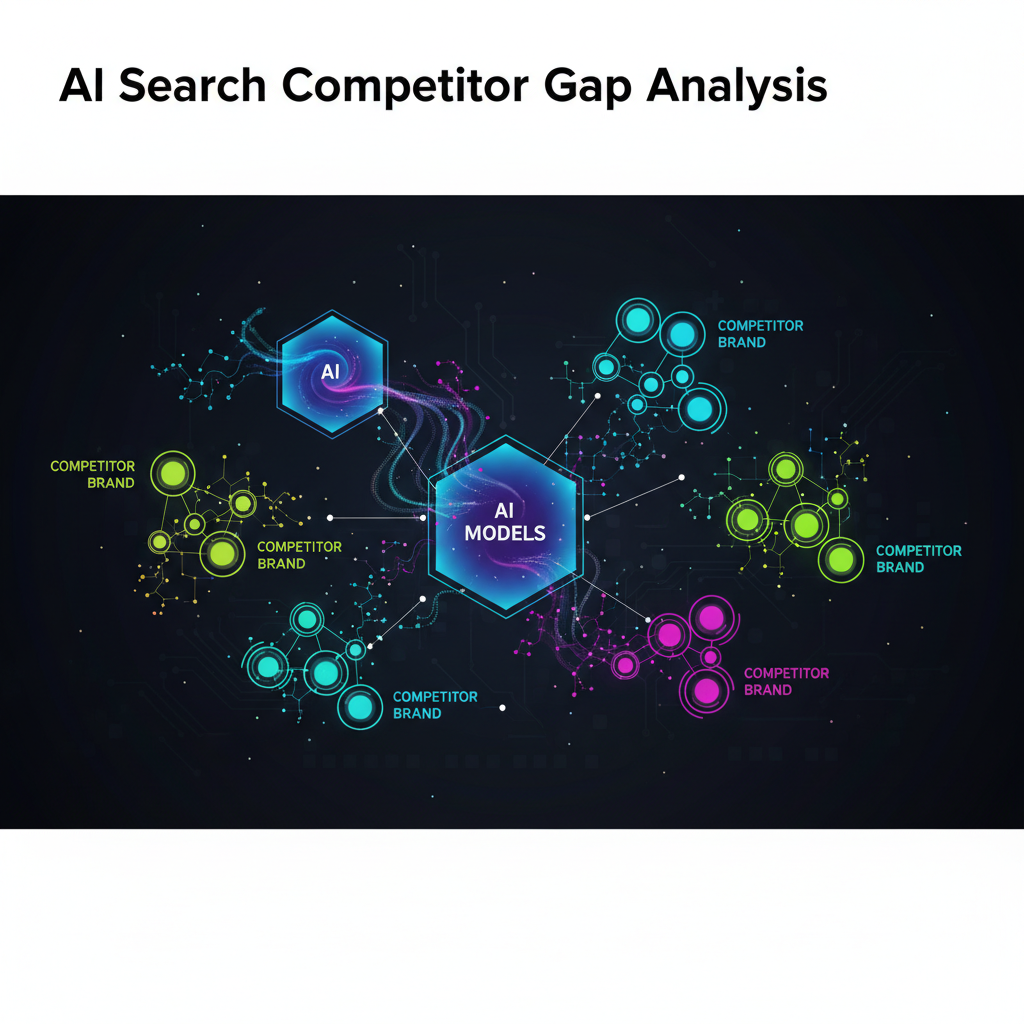
AI Search Competitor Gap Analysis: Uncovering Opportunities
The evolving digital landscape demands a new approach to understanding your market position, and AI search competitor gap analysis is at its forefront. This critical process involves tracking how large language models (LLMs) like ChatGPT, Perplexity, and Gemini describe and recommend your competitors, moving beyond traditional keyword rankings to analyze narratives, sentiment, and share of voice within AI-generated answers. By systematically identifying where competitors excel in AI search, businesses can uncover significant opportunities to refine their digital strategies and enhance visibility in the age of generative AI.
Understanding the AI Search Competitor Landscape: Why is an AI Answer Competitor Audit Essential?
An AI answer competitor audit is crucial for businesses aiming to maintain relevance and visibility in today’s search environment, as it reveals how AI models perceive and present information about your industry rivals. This audit moves beyond traditional SEO metrics to focus on how competitors are framed, compared, and recommended in AI-generated responses, which are increasingly replacing traditional search results. With users often receiving direct answers from AI without clicking through to websites, understanding this new competitive playing field is paramount. For more insights, check out our guide on Digital Marketing Services.

The purpose of an AI answer competitor audit is to identify the specific narratives, sentiment, and sources that AI models use when discussing your competitors. Unlike traditional SEO, which tracks keyword rankings, an AI audit focuses on the “generative share of voice” – how often a competitor is mentioned or recommended in AI conversations about your industry. This provides actionable insights into their perceived strengths and weaknesses, helping you understand why AI might favor them over your brand.
What is an AI Answer Competitor Audit and How Does it Inform Strategy?
An AI answer competitor audit is a systematic evaluation of how your competitors appear in and are described by AI-generated search results and conversational AI platforms. It involves analyzing the specific language, tone, and factual points AI models use to synthesize information about competing brands. This audit informs strategy by highlighting content gaps, narrative discrepancies, and opportunities for your brand to gain a more favorable position in AI answers. For instance, if an AI consistently describes a competitor as an “industry leader,” it signals a need to bolster your own content’s authority and expertise.
Key elements examined during an AI answer competitor audit include:
* Generative Share of Voice: The percentage of AI responses where a competitor is cited or recommended.
* Citation Sources: The specific third-party websites, reviews, or articles the AI uses to verify its recommendations.
* Brand Sentiment: Whether the AI’s description of a competitor is positive, negative, or neutral.
* Narrative Framing: The adjectives and context used by AI to describe competitors, such as “budget option” versus “premium choice”.
Identifying Top Competitors in the Evolving AI Search Environment
Identifying your true competitors in the AI search environment requires a broader perspective than traditional SEO competitor analysis. Your AI competitors might not only be your direct business rivals but also niche blogs, research papers, or technical forums that AI models cite as authoritative sources. Tools like Ahrefs’ Brand Radar or Semrush’s AI Visibility Toolkit can help identify brands that AI mentions alongside yours, cites as sources, or that your audience compares to you in AI searches. This expanded view ensures you’re monitoring all entities influencing AI-driven recommendations.
For example, a traditional competitor might be another e-commerce store selling similar products. However, in AI search, a competitor could also be a popular review site that consistently ranks high in AI-generated summaries for product comparisons, even if they don’t sell products directly. A comprehensive approach involves:
1. Prompt-Set Analysis: Evaluating competitor performance across a curated set of user prompts and questions relevant to your business.
2. Multi-Engine Benchmarking: Comparing AI visibility across different generative AI platforms (e.g., ChatGPT, Perplexity, Google AI Overview).
3. Source Auditing: Mapping the citation graph to understand which third-party websites are feeding the AI information about your brand and rivals.
Conducting a Comprehensive GEO Competitor Analysis for AI Search Dominance
A comprehensive GEO competitor analysis is essential for achieving AI search dominance, as AI engines increasingly use location as a core ranking signal to provide personalized and relevant answers. This means that your visibility in AI search is not global by default; rather, it is directly influenced by where your customer is located. Businesses without a strong local presence or weak local signals are less likely to appear in AI-generated answers for location-specific queries.

While some studies suggest AI Overviews might show consistency across broader geographies like US states for general queries, location becomes a significant factor for local search queries and when AI adapts responses based on user location and regional availability. For businesses, this emphasizes the need to optimize for local signals to ensure they are featured in AI answers for users in key regions.
How Does Geographic Location Impact AI Search Visibility?
Geographic location significantly impacts AI search visibility because AI engines adapt responses based on the user’s location, learning from local behavior patterns and prioritizing brands available in that region. For instance, a user in London asking for “best coffee shop near me” will receive different AI-generated results than a user in New York, even if the underlying query is similar. AI models filter results using geolocation, giving strong weight to local listings, mentions, and reviews. This means that a business with a robust local SEO presence is more likely to be recommended by AI for geographically relevant queries.
Key ways location affects AI search visibility include:
* Core Ranking Signal: AI engines use location as a fundamental factor in determining relevance.
* Local Behavior Patterns: AI learns from and adapts to local user preferences and search behaviors.
* Personalized Experiences: Location data enables AI to deliver highly personalized answers.
* Local Listings and Mentions: Strong local listings and mentions are crucial drivers of visibility.
Tools and Techniques for Effective Local AI Search Competitor Research
Effective local AI search competitor research requires specialized tools and techniques to uncover how rivals are performing in specific geographic areas. Traditional SEO tools like Semrush and Ahrefs have begun incorporating features for AI search visibility monitoring and competitive analysis, including GEO-specific insights. Platforms such as Scrunch AI also help map brand presence in AI conversations, focusing on mentions, sentiment, and content gaps within a local context. These tools allow businesses to track their “AI visibility score” and “generative share of voice” across major AI models within defined geographic parameters.
Techniques for local AI search competitor research include:
* Local Prompt Testing: Running specific, location-based queries in AI models to see which competitors are recommended.
* Analyzing Local Citations: Identifying local directories, review sites, and news outlets that AI models cite for competitor information.
* Monitoring Local Sentiment: Assessing the sentiment of AI-generated answers about local competitors.
* Optimizing Google Business Profile: Ensuring your Google Business Profile is fully optimized with accurate, up-to-date information, as this is a strong local signal for AI.
By leveraging these tools and techniques, businesses can perform a thorough GEO competitor analysis to identify regional strengths and weaknesses, enabling them to tailor content and SEO strategies for local AI search dominance. For more insights into how to refine your digital presence, consider exploring our Digital Marketing Services.
Uncovering Gaps with Brand Mention Gap Analysis in AI-Powered Search
Brand mention gap analysis is a crucial strategy for identifying missed opportunities in AI-powered search, as AI models increasingly rely on brand mentions—even without direct links—to assess a brand’s relevance, authority, and influence. Unlike traditional SEO that heavily emphasized backlinks, AI search uses mentions as “data points” and signals of real-world recognition. When an AI model is trained or performs a real-time search, it looks for co-occurrence: if your brand name frequently appears near high-value keywords, the AI’s internal “probability engine” deems you a relevant answer.
This analysis helps uncover where your brand is underrepresented in AI conversations compared to competitors, even if your traditional SEO rankings are strong. A brand mention is defined as any reference to a brand’s name, product, or service in content, online or offline, regardless of whether it includes a clickable link. These mentions can appear in social media posts, blogs, news articles, forums, and customer reviews, all of which contribute to how both people and machines perceive your authority.
What is Brand Mention Gap Analysis and Why Does it Matter for AI Search?
Brand mention gap analysis is the process of identifying instances where your competitors are being mentioned in AI-generated responses and online content, but your brand is not, for similar topics or queries. This matters significantly for AI search because AI engines prioritize the “Entity” over the “URL,” meaning a mention can be as valuable as a backlink in establishing brand authority and visibility. Mentions drive brand awareness, topical authority, and trust signals, even without referral data, because users often copy a mentioned brand name and search for it later.
The core dimensions of a brand gap analysis include:
* Visibility Gap: Where your brand appears less often than competitors in AI results.
* Narrative Gap: How AI or media describe your brand versus your desired positioning.
* Topic Gap: Topics or themes you should be associated with but aren’t.
* Web Mentions Gap: External sources that mention competitors but not you.
Strategies for Monitoring and Leveraging Brand Mentions in AI Answers
To effectively monitor and leverage brand mentions in AI answers, businesses need a strategic approach that combines advanced tools with content optimization. Start by using AI competitor monitoring tools like Ahrefs’ Brand Radar, Semrush’s AI Visibility Toolkit, or specialized platforms like Scrunch AI, which track brand mentions and sentiment across various AI engines. These tools can help you:
* Benchmark Visibility: Compare your brand’s mentions, citations, and AI Share of Voice against competitors.
* Identify Gaps: Find topics and prompts where competitors are mentioned or cited, but your brand is not.
* Analyze Context: Understand the specific narratives and sentiment surrounding competitor mentions.
Once gaps are identified, leverage these insights to:
* Create Authoritative Content: Develop comprehensive, expert-driven content that thoroughly addresses topics where competitors are gaining mentions.
* Boost Digital PR: Engage with third-party sites, media outlets, and niche communities to foster organic mentions from trusted sources.
* Optimize for E-E-A-T: Emphasize Experience, Expertise, Authoritativeness, and Trust in your content, as AI models prioritize credible sources.
By actively monitoring and strategically cultivating brand mentions, businesses can significantly improve their visibility and influence within AI-generated search results, ensuring their brand is part of the conversation.
Assessing ChatGPT Competitor Visibility: Beyond Traditional SERP Rankings
Assessing ChatGPT competitor visibility requires a distinct approach that goes beyond traditional SERP rankings, as ChatGPT and other conversational AI tools provide direct, synthesized answers rather than a list of blue links. Users are increasingly turning to AI for quick, contextual, and tailored responses, often bypassing traditional search engines for complex queries, product evaluations, and explanations. This shift means that a brand’s presence in AI-generated answers is becoming as crucial as its position in Google’s organic results.
Unlike traditional search, which focuses on keyword relevance and authority for ranking, ChatGPT prioritizes the relevance of content, summaries, comparisons, and actionable insights within a single answer. This necessitates a re-evaluation of how businesses track and improve their visibility, focusing on how their brand is mentioned, cited, and recommended within these conversational AI environments.
How Does ChatGPT Influence Competitor Visibility in AI Search Results?
ChatGPT significantly influences competitor visibility in AI search results by providing direct, conversational answers that can summarize complex topics quickly and require fewer clicks than traditional Google searching. When users ask ChatGPT for recommendations or information, the AI synthesizes data from various sources to present a concise answer, often mentioning specific brands. If a competitor is frequently mentioned or cited favorably in these responses, they gain a substantial advantage in brand awareness and trust, even without a direct click-through to their website.
Key ways ChatGPT impacts competitor visibility:
* Direct Answers: ChatGPT provides comprehensive answers, reducing the need for users to visit multiple websites.
* Brand Recall: Mentions in ChatGPT answers drive brand recall and awareness, as users often search for mentioned brands later.
* Trust and Authority: Brands consistently mentioned in positive contexts by ChatGPT gain perceived authority and trust.
* Zero-Click Searches: The rise of zero-click searches means visibility in AI answers is critical, as users get their information directly.
Measuring and Improving Your Presence in Conversational AI Search
Measuring and improving your presence in conversational AI search, particularly for platforms like ChatGPT, involves a new set of metrics and strategic actions. Traditional rank tracking tools are often “blind” to how brands are framed or recommended inside generative answers. Instead, focus on metrics specific to the generative ecosystem:
Key Metrics for Conversational AI Visibility:
* AI Visibility Score: A composite metric quantifying overall presence and prominence in AI responses.
* Generative Share of Voice: How often your brand is brought up in conversations about your industry by AI.
* Citation Frequency: How often ChatGPT links to or references your specific content.
* Brand Sentiment: The qualitative assessment of how AI describes your brand (e.g., “innovative,” “expensive”).
* Competitor Displacement Rate: Instances where your brand appears, and competitors do not.
Strategies for Improvement:
1. Prompt Testing Framework: Build a structured framework to test a curated set of user prompts across platforms like ChatGPT and Gemini, documenting competitor mentions and scoring visibility.
2. Structured, Comprehensive Content: Create content that is well-structured with clear headings, FAQs, and definitions, making it easy for AI to parse and synthesize.
3. Strengthen Topical Authority: Publish in-depth, expert-driven content on topics relevant to your brand, building an internal linking mesh to connect related pages.
4. Optimize for Conversational Queries: Structure content to directly answer questions and anticipate follow-up queries, mirroring natural language interactions.
5. Build Off-Page Signals & Brand Mentions: Actively seek mentions across trusted third-party sites, reviews, and news articles, as these build credibility for AI models.
By adopting these strategies, businesses can effectively measure their ChatGPT competitor visibility and implement targeted optimizations to secure a stronger presence in the evolving AI search landscape.
Strategic Implications of AI Search Competitor Insights: Actionable Steps for Growth
The strategic implications of AI search competitor insights are profound, demanding a shift from traditional SEO tactics to a more holistic, AI-centric approach to digital marketing. Understanding how competitors are winning in AI-generated answers provides a roadmap for identifying content gaps, refining brand narratives, and optimizing for new visibility signals that traditional analytics often miss. Businesses that effectively leverage these insights can proactively adjust their strategies to secure a dominant position in the evolving search landscape.
The core challenge lies in translating raw competitor data into actionable steps that drive growth. This involves not just knowing who is being mentioned by AI, but why, how, and where they are gaining this advantage. By analyzing the depth of their guides, structured formatting, FAQ integration, clear positioning statements, and external authority signals, businesses can uncover the underlying drivers of competitor success in AI search.
Translating AI Competitor Data into Content and SEO Strategies
Translating AI competitor data into effective content and SEO strategies involves a multi-faceted approach focused on optimizing for AI’s understanding of content and authority. First, identify “prompt gaps” where competitors appear in AI responses but your brand does not, then map these prompts to content opportunities. This means creating comprehensive, expert-driven content that directly answers those queries, ensuring it is well-structured with clear headings, tables, and FAQ sections that AI can easily interpret.
Consider the following table for a comparison of traditional vs. AI-driven content strategy:
| Aspect | Traditional SEO Content Strategy | AI-Driven Content Strategy |
|---|---|---|
| Primary Goal | Rank for keywords, drive clicks | Be recommended/cited by AI, provide direct answers |
| Keyword Focus | High-volume, short-tail keywords | Long-tail, conversational, intent-driven queries |
| Content Structure | Paragraphs, keyword density | Clear headings, FAQs, structured data, definitions, tables |
| Authority Signals | Backlinks, domain authority | Brand mentions, citations, E-E-A-T, topical authority |
| Success Metrics | Keyword rankings, organic traffic | AI visibility score, generative share of voice, citation frequency |
Furthermore, strengthen your topical authority by building content clusters and internal linking structures that demonstrate comprehensive coverage of a subject. Leverage schema markup to give AI models clear hints about your content’s context and meaning, improving its chances of appearing in AI summaries.
Future-Proofing Your Digital Strategy Against Evolving AI Search
Future-proofing your digital strategy against evolving AI search requires continuous adaptation, focusing on creating value-driven, intent-focused content that resonates across multiple channels and AI platforms. Since AI search technology evolves rapidly, staying informed about updates to major AI platforms and changes in how they process information is critical. This means not just reacting to changes but proactively experimenting with different content formats and structures to identify what resonates best with AI systems.
Key steps to future-proof your strategy include:
* User-First Content: Always prioritize writing for users first, ensuring human engagement remains the priority, even while structuring content for AI.
* Omni-Channel Strategy: Avoid relying heavily on one marketing channel; build an omni-channel presence to maximize your brand’s potential in the AI era.
* Continuous Monitoring: Implement AI competitor monitoring tools to track shifts in competitor visibility, sentiment, and narratives monthly or quarterly.
* Adaptable Content: Create adaptable content that can be easily repurposed for various AI-driven formats, including voice search summaries and AI overviews.
* Focus on E-E-A-T: Continuously build and demonstrate Experience, Expertise, Authoritativeness, and Trust (E-E-A-T) through your content and brand mentions, as these are crucial AI ranking factors.
By embracing these actionable steps, businesses can effectively translate AI competitor insights into a robust digital strategy that not only closes current gaps but also positions them for sustained growth in the dynamic world of AI search.
What is the primary difference between AI search competitor analysis and traditional SEO competitor analysis?
The primary difference is that AI search competitor analysis focuses on how competitors are described, recommended, and cited within AI-generated answers, rather than just their keyword rankings in traditional search results. It tracks narratives, sentiment, and generative share of voice.
How important are brand mentions for AI search visibility?
Brand mentions are critically important for AI search visibility. AI models use unlinked mentions as data points to assess a brand’s relevance and authority, often valuing them as much as, or even more than, traditional backlinks in establishing topical strength and trust.
Does geographic location affect AI search results?
Yes, geographic location significantly affects AI search results. AI engines adapt responses based on the user’s location, prioritizing brands with a strong local presence, local listings, and positive local reviews, especially for “near me” or region-specific queries.
Can AI tools help identify content gaps for AI search?
Absolutely. AI competitor gap analysis agents and other AI-powered tools can systematically examine competitor content, identify areas where they excel, and reveal topics, keywords, or strategies your site may be missing in AI-generated answers.
How can businesses measure their ChatGPT visibility?
Businesses can measure ChatGPT visibility by tracking metrics like AI Visibility Score, Generative Share of Voice, Citation Frequency, and Brand Sentiment. This often involves using specialized AI visibility tools or prompt-testing frameworks to see how often and how favorably their brand is mentioned.
What is an AI answer box, and how does it relate to competitor analysis?
An AI answer box is a direct, synthesized response provided by an AI search engine, often appearing at the top of search results, aiming to answer a user’s query without requiring a click. In competitor analysis, understanding who appears in these boxes and how they are described is crucial for AI visibility.
Why is it important to optimize for conversational queries in AI search?
Optimizing for conversational queries is vital because AI search engines, like ChatGPT, excel at understanding natural language and providing comprehensive answers to complex, human-like questions. Structuring content to address these queries directly increases the likelihood of being featured in AI-generated responses.
The shift towards AI-powered search represents a fundamental change in how brands achieve visibility and connect with their audience. Proactive AI search competitor gap analysis is no longer optional; it’s a strategic imperative for digital survival and growth.
Key takeaways for navigating this new landscape include:
* Focus on AI-Native Metrics: Move beyond traditional keyword rankings to track generative share of voice, brand sentiment, and citation frequency in AI responses.
* Expand Competitor Definition: Recognize that AI competitors can include niche content creators and authoritative sources, not just direct business rivals.
* Prioritize Brand Mentions: Actively cultivate high-quality, contextual brand mentions across diverse online platforms to build AI-recognized authority.
* Optimize for Direct Answers: Structure content with clear FAQs, definitions, and comprehensive answers to maximize your chances of appearing in AI answer boxes.
* Embrace GEO Strategies: Tailor your digital presence to specific geographic locations, as AI increasingly personalizes results based on user location.
* Continuously Adapt: Stay agile and responsive to the rapid evolution of AI search technologies and algorithms.
By integrating these insights and continuously refining your digital strategy, your brand can effectively close competitive gaps and thrive in the era of generative AI. To learn more about how to elevate your brand’s presence in this dynamic environment, explore our specialized digital marketing services.