

Mastering Incrementality Testing Paid Social Campaigns
Incrementality testing paid social is a crucial methodology that helps marketers understand the true causal impact of their advertising spend on platforms like Meta. It moves beyond last-click attribution, revealing how much additional business your paid social efforts generate that wouldn’t have occurred otherwise. By isolating the true lift, businesses can optimize their budgets more effectively and prove the real value of their social media advertising. This advanced testing approach ensures that every dollar spent is genuinely contributing to growth, providing a clearer picture of return on investment than traditional measurement models.
Understanding Paid Social Lift Tests: Why They Matter
A paid social lift test quantifies the true incremental impact of advertising campaigns by comparing the behavior of an exposed group to a control group that did not see the ads. This method is essential because it directly measures the additional conversions, revenue, or other desired outcomes generated solely by the advertising, rather than attributing all conversions to the last touchpoint. Without lift testing, marketers risk overestimating their campaign’s effectiveness, leading to misallocated budgets and suboptimal strategies. It provides a scientific approach to understanding causality in a complex digital ecosystem.
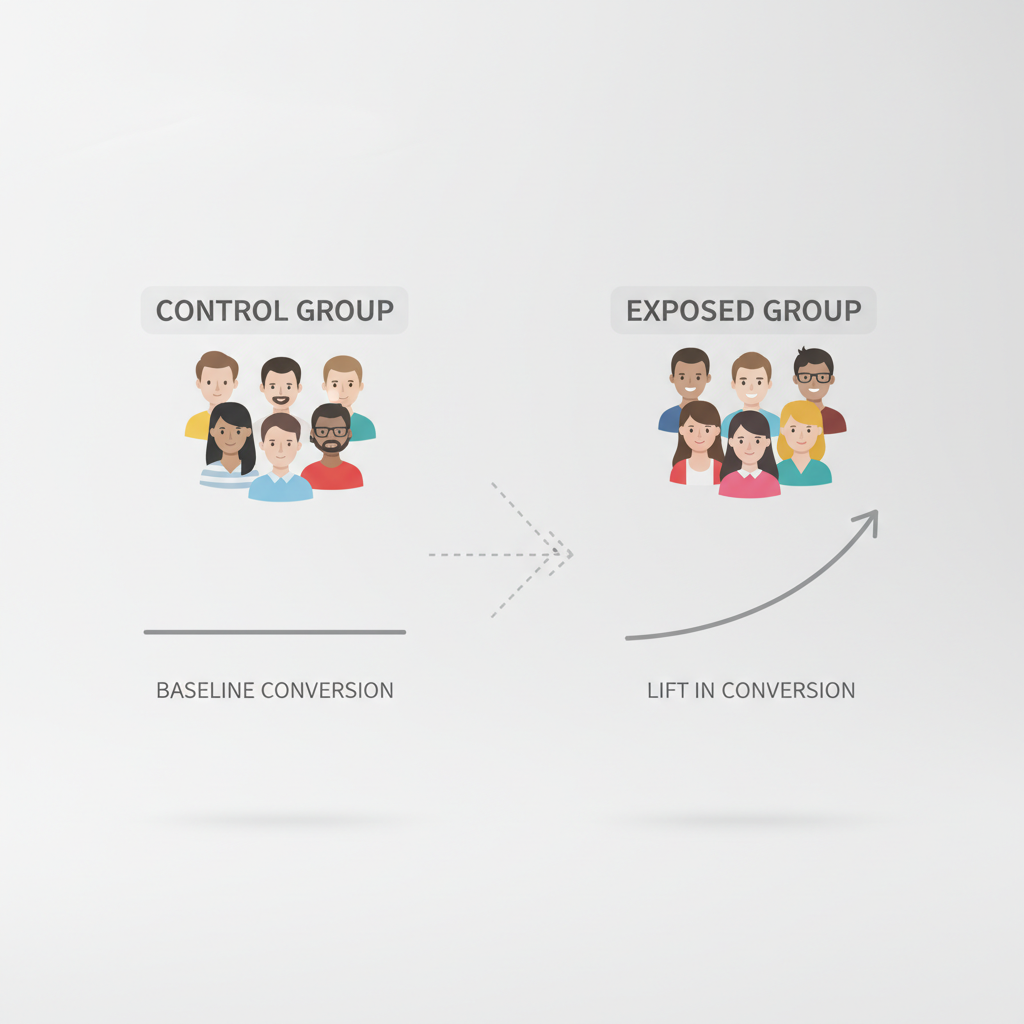
Traditional attribution models often fall short in today’s multi-touchpoint customer journeys. They tend to give too much credit to the last interaction, ignoring the influence of earlier touchpoints or the baseline organic activity. Incrementality testing paid social addresses this by creating a true counterfactual: what would have happened if the ads weren’t shown? This allows businesses to accurately assess the unique contribution of their paid social efforts. It’s particularly vital for mature brands with strong organic presence, where distinguishing between organic and paid impact can be challenging.
The Limitations of Last-Click Attribution in Paid Social
Last-click attribution, while simple, fails to capture the full customer journey and often misrepresents the value of upper-funnel activities. It assigns 100% of the conversion credit to the final ad click or impression before a conversion, neglecting all prior interactions. This can lead to an undervaluation of paid social campaigns that drive awareness and consideration, even if they don’t directly lead to the final click. Marketers using last-click models might prematurely cut effective campaigns because their direct ROI appears low, even if they are crucial for nurturing leads.
Why Incrementality is the Gold Standard for Measuring True ROI
Incrementality measurement is considered the gold standard because it directly answers the question: “Would this conversion have happened anyway?” By isolating the impact of the ad exposure, marketers can determine the true return on ad spend (ROAS). This deeper insight allows for more strategic budget allocation, shifting investment towards campaigns and platforms that genuinely drive new value. It helps to prevent wasted ad spend on audiences who would have converted organically, ensuring resources are directed where they can make the most difference. Understanding this true lift is fundamental for sustainable growth and competitive advantage in digital advertising.
Designing Effective Holdout Test Marketing Strategies
Designing an effective holdout test marketing strategy involves carefully segmenting your audience and implementing a robust methodology to ensure accurate measurement of incremental lift. A holdout test, often referred to as a ghost ad test or geo-lift test, creates a control group that is deliberately not exposed to a specific ad campaign, allowing for a direct comparison with an exposed group. This deliberate non-exposure is critical for isolating the causal effect of your advertising efforts. Proper design minimizes bias and maximizes the reliability of your results, providing actionable insights for future campaigns.

The core principle of a holdout test is to establish a truly comparable control group. This means ensuring that the control group is statistically similar to the exposed group in terms of demographics, past behavior, and other relevant characteristics. Randomization is key to achieving this comparability. For instance, you might randomly assign users within a specific geographic area or a defined audience segment into either the test or control group. This rigorous approach is fundamental for any campaign incrementality measurement and for obtaining reliable data.
Key Considerations for Audience Segmentation and Control Groups
Effective audience segmentation is paramount for a successful holdout test. Marketers must define their target audience clearly and then randomly divide it into two groups:
* Test Group: Exposed to the paid social campaign.
* Control Group (Holdout Group): Not exposed to the paid social campaign.
When conducting a Meta ads incrementality test, Meta’s own tools can assist with this segmentation, often using pixel data or other audience definitions. It’s crucial that the control group is large enough to be statistically significant and that there’s no spillover where control group members inadvertently see the ads. Careful consideration of audience size and homogeneity ensures that any observed differences between the groups can be confidently attributed to the advertising.
Choosing the Right Test Methodology: Geo vs. User-Level Holdouts
There are primarily two types of holdout test methodologies, each with its own advantages and challenges:
1. Geo-Lift Tests: These tests segment audiences by geographic location. One region (or set of regions) serves as the test group, receiving the ads, while another comparable region acts as the control group, receiving no ads.
* Pros: Reduces the risk of “spillover” (control group seeing ads), easier to implement for broad campaigns.
* Cons: Requires geographically distinct and comparable markets, can be less precise if regions aren’t perfectly matched.
2. User-Level Holdouts: These tests randomly assign individual users within a target audience to either the test or control group. This is often done programmatically by platforms like Meta.
* Pros: Higher precision due to individual-level randomization, works well for highly targeted campaigns.
* Cons: Potential for “spillover” if users interact across devices or platforms, requires robust tracking mechanisms.
The choice between geo and user-level holdouts depends on the campaign’s objectives, available data, and the specific platform capabilities. For comprehensive Digital Marketing Services, understanding these distinctions is vital for accurate measurement and optimization. Each method aims to create a clean comparison, but their implementation varies significantly.
Executing Meta Ads Incrementality Studies
Executing Meta ads incrementality studies requires a structured approach, leveraging Meta’s platform capabilities to set up, run, and monitor tests effectively. Meta provides tools and methodologies that allow advertisers to measure the true incremental value of their campaigns, moving beyond simple attribution to understand causation. This involves careful planning of the experiment, precise targeting, and consistent monitoring to ensure the integrity of the test. A well-executed study on Meta can provide invaluable insights into the true performance of your ad spend. For more insights, check out our guide on Digital Marketing Services.
Meta’s platform offers various options for setting up incrementality tests, often involving a split-test feature or working with their measurement partners. The goal is always to create a clear separation between an exposed group and a control group within the Meta ecosystem. This allows for a direct comparison of key performance indicators (KPIs) between those who saw the ads and those who did not. Understanding these differences is how marketers can accurately calculate the lift generated by their paid social lift test.
Step-by-Step Guide to Setting Up an Incrementality Test on Meta
Setting up an incrementality test on Meta typically involves these steps:
1. Define Your Hypothesis: Clearly state what you expect to achieve and what you want to learn (e.g., “Running a conversion campaign will increase purchases by X% incrementally”).
2. Select Your Test Type: Choose between user-level holdouts (often through Meta’s built-in A/B test features) or geo-lift tests, depending on your goals and audience.
3. Audience Segmentation: Define your target audience and ensure proper randomization into test and control groups. Meta’s tools can help create these splits.
4. Campaign Setup: Configure your ad campaigns for the test group, ensuring the control group is completely excluded from seeing these specific ads.
5. Duration and Budget: Determine an appropriate test duration (usually 2-4 weeks for statistical significance) and allocate sufficient budget to generate meaningful data.
6. Tracking and Measurement: Ensure your Meta Pixel and conversion tracking are correctly implemented and firing accurately for both groups.
7. Launch and Monitor: Launch the campaigns and continuously monitor for any anomalies or issues that could compromise the test’s validity.
Best Practices for Ensuring Test Validity and Statistical Significance
To ensure the validity and statistical significance of your campaign incrementality measurement on Meta, consider these best practices:
* Randomization: Strive for truly random assignment to test and control groups to minimize bias.
* Sufficient Sample Size: Ensure both groups are large enough to detect a statistically significant difference if one exists. Small sample sizes can lead to inconclusive results.
* Test Duration: Run the test long enough to capture typical user behavior cycles and accumulate enough data, but not so long that external factors significantly interfere.
* Consistent Campaign Parameters: Keep all other variables constant between the test and control groups, except for the ad exposure itself.
* Avoid Overlapping Tests: Do not run multiple, conflicting incrementality tests on the same audience simultaneously, as this can contaminate results.
* Monitor for Spillover: Actively try to prevent or account for situations where the control group might inadvertently be exposed to the ads.
* Pre-Test Analysis: Analyze baseline performance before the test to ensure the groups are comparable.
Adhering to these guidelines will help ensure that your Meta ads incrementality studies yield reliable and actionable insights, allowing you to make data-driven decisions about your paid social strategy.
Analyzing Campaign Incrementality Measurement Results
Analyzing campaign incrementality measurement results goes beyond simply comparing raw numbers; it involves statistical rigor to determine the true causal lift attributable to your paid social efforts. The primary goal is to ascertain if the difference in performance between your exposed group and your control group is statistically significant, meaning it’s unlikely to have occurred by chance. This analytical phase transforms raw data into actionable insights, helping marketers understand the genuine impact of their advertising. A thorough analysis provides the evidence needed to justify budget decisions and optimize future campaigns.
The core of this analysis is calculating the “lift” or “incrementality.” This is typically done by subtracting the performance of the control group from the performance of the test group. For example, if the test group had a 5% conversion rate and the control group had a 3% conversion rate, the incremental lift would be 2 percentage points. However, it’s crucial to then apply statistical tests to confirm this difference is meaningful. Understanding this nuanced approach is vital for any effective paid social lift test.
Calculating Incremental Lift and Statistical Significance
To calculate incremental lift, follow these steps:
1. Identify Key Metrics: Choose the primary KPIs you want to measure (e.g., purchases, leads, app installs, revenue).
2. Gather Data: Collect data for both the test and control groups for the chosen metrics over the test period.
3. Calculate Baseline Performance: Determine the control group’s performance for each metric. This represents what would have happened without the ads.
4. Calculate Test Group Performance: Determine the test group’s performance for each metric.
5. Compute Absolute Lift: Subtract the control group’s performance from the test group’s performance (Test Group Metric – Control Group Metric = Absolute Lift).
6. Compute Relative Lift: Divide the absolute lift by the control group’s performance and multiply by 100% (Absolute Lift / Control Group Metric * 100% = Relative Lift).
Once the lift is calculated, statistical significance tests (e.g., t-tests, chi-squared tests) are applied. These tests help determine the probability that the observed difference is due to random chance. A p-value below a certain threshold (commonly 0.05) indicates statistical significance, meaning there’s a low probability the results are coincidental. This is a critical step in validating your holdout test marketing efforts.
Interpreting Results: What a Positive, Negative, or Neutral Lift Means
Interpreting the results of your incrementality test provides direct guidance for your marketing strategy:
* Positive Lift: A statistically significant positive lift indicates that your paid social campaign genuinely drove additional desired outcomes. This means the campaign is effective and likely warrants continued or increased investment. It confirms that your Meta ads incrementality efforts are creating new value.
* Neutral Lift (No Significant Difference): If there’s no statistically significant difference between the test and control groups, it suggests your campaign did not generate incremental value. This could mean the ads were ineffective, targeting was off, or the audience would have converted organically anyway. In this scenario, the ad spend might be better reallocated.
Negative Lift: A rare but possible outcome, a negative lift (where the control group performs better* than the test group) suggests the campaign might be actively harming performance. This could be due to ad fatigue, negative brand perception from the ads, or cannibalization of organic efforts. Immediate investigation and campaign adjustments are necessary.
Understanding these outcomes is crucial for making informed decisions about your paid social budget and strategy.
Optimizing Paid Social Spend with Incrementality Insights
Optimizing paid social spend with incrementality insights allows marketers to reallocate budgets more effectively, focusing on campaigns and channels that deliver genuine incremental value. By understanding which campaigns truly drive new business, rather than just capturing existing demand, businesses can achieve a higher return on ad spend (ROAS). This data-driven approach moves beyond superficial metrics, providing a deeper understanding of where marketing dollars are most impactful. It enables a strategic shift from simply spending to investing in growth.
The insights gained from a paid social lift test are powerful because they reveal the true efficiency of your advertising. For example, if a campaign shows a high incremental lift at a reasonable cost, it’s a strong candidate for increased investment. Conversely, if a campaign shows little to no incremental lift, even if it appears to have a good ROAS under a last-click model, it indicates that the spend might be inefficient. This level of granular understanding is essential for maximizing budget efficiency and achieving sustainable growth.
Reallocating Budgets Based on True Incremental Value
Reallocating budgets based on true incremental value involves a strategic review of all active campaigns and channels. This process typically includes:
1. Identifying High-Performing Incremental Campaigns: Prioritize campaigns that demonstrate a statistically significant positive incremental lift. These are the campaigns that are genuinely growing your business.
2. Reducing or Pausing Low-Incremental Campaigns: Campaigns showing neutral or negative incremental lift should be scaled back or paused. The budget saved can then be reallocated to more effective initiatives.
3. Testing New Strategies: Use incrementality testing to evaluate new creative, targeting, or bidding strategies before rolling them out broadly. This ensures new approaches are truly additive.
4. Channel Optimization: Apply incrementality insights across different paid social platforms. A campaign performing well on Meta might not be incremental on another platform, and vice versa.
This continuous cycle of testing, analyzing, and reallocating is fundamental to an optimized paid social strategy. For businesses seeking to refine their digital marketing efforts, exploring Our Next-Gen Services can provide expert guidance in applying these sophisticated measurement techniques.
Improving Targeting, Creative, and Bidding Strategies
Incrementality insights offer specific guidance for improving various aspects of your paid social campaigns:
* Targeting: If a specific audience segment shows high incremental lift, double down on that segment. If another segment shows low lift, refine the targeting or consider excluding it. Holdout test marketing can reveal which demographic or interest groups respond most incrementally.
* Creative: Test different ad creatives to see which ones drive the highest incremental response. Sometimes, a creative that performs well in terms of clicks might not be the one that drives true incremental conversions.
* Bidding Strategies: Experiment with different bidding strategies (e.g., lowest cost, cost cap) within an incrementality framework. Determine which strategy delivers the most incremental conversions at the most efficient cost.
| Strategy Area | Traditional Attribution Insight | Incrementality Insight |
|---|---|---|
| Targeting | Audience X has high ROAS. | Audience X has high incremental ROAS; Audience Y’s conversions were mostly organic. |
| Creative | Ad A has the highest CTR. | Ad B, despite lower CTR, drives significantly more new purchases. |
| Budget Allocation | Spend more on campaigns with high reported ROAS. | Spend more on campaigns with high incremental lift, even if reported ROAS seems similar. |
| Channel Effectiveness | Facebook ads have a good last-click conversion rate. | Facebook ads drive X% incremental revenue; Google Search ads drive Y% incremental revenue. |
By systematically applying these insights, marketers can ensure their Meta ads incrementality efforts are not just driving activity, but genuinely fueling business growth.
Overcoming Challenges in Incrementality Testing Paid Social
While incrementality testing paid social offers unparalleled insights, it comes with its own set of challenges that marketers must address for accurate and reliable results. These challenges range from technical complexities in test setup to ensuring statistical validity and managing external factors. Overcoming these hurdles is crucial for leveraging incrementality to its full potential and making truly data-driven decisions. A proactive approach to anticipating and mitigating these issues can significantly improve the quality of your test outcomes.
One of the primary difficulties lies in maintaining a truly clean control group. In the interconnected digital world, preventing a control group from being exposed to any form of advertising from your brand can be difficult. This “spillover” can contaminate results and lead to an underestimation of the true incremental lift. Addressing these practical issues is a key part of successful campaign incrementality measurement.
Addressing Data Privacy Changes and Signal Loss
Recent data privacy changes, such as Apple’s App Tracking Transparency (ATT) framework and the deprecation of third-party cookies, have introduced significant challenges for incrementality testing. These changes lead to signal loss, making it harder to track users across platforms and accurately attribute conversions.
* Limited User-Level Data: Reduced access to individual user data makes precise user-level holdouts more difficult.
* Reliance on Aggregated Data: Marketers must increasingly rely on aggregated and modeled data, which can introduce some level of imprecision.
* Platform-Specific Solutions: Platforms like Meta are developing their own privacy-preserving measurement solutions, which marketers must adapt to. This often involves using advanced modeling or privacy-enhanced APIs.
To mitigate these issues, marketers should:
* Prioritize first-party data collection.
* Leverage server-side tracking (Conversions API for Meta).
* Explore advanced statistical modeling techniques.
* Work closely with platform measurement partners.
These adaptations are essential for continuing to perform robust Meta ads incrementality studies in a privacy-first world.
Mitigating External Factors and Confounding Variables
External factors and confounding variables can significantly impact incrementality test results, making it difficult to isolate the true effect of your paid social campaigns. These can include:
* Seasonality: Sales naturally fluctuate with seasons and holidays. Running a test during a major holiday without accounting for it can skew results.
* Competitor Activity: A sudden surge in competitor advertising or a major product launch could impact your baseline and test group performance.
* PR/News Events: Positive or negative media coverage about your brand or industry can influence consumer behavior independently of your ads.
* Other Marketing Channels: Concurrent campaigns on other channels (e.g., email, organic search, TV) can influence the test and control groups, making it harder to attribute lift solely to paid social.
To mitigate these, consider:
* Longer Test Durations: Running tests for a longer period can help smooth out short-term fluctuations.
* Pre-Test Baselines: Establish a clear baseline performance before the test to account for natural trends.
* Geo-Lift Tests: These can sometimes be less susceptible to user-level external factors if regions are well-matched.
* Statistical Controls: Use advanced statistical methods to control for known external variables during analysis.
* Careful Planning: Coordinate incrementality tests with other marketing activities to minimize interference.
By actively planning for and addressing these challenges, marketers can enhance the accuracy and reliability of their holdout test marketing efforts, leading to more trustworthy insights and better decision-making.
What is the primary goal of incrementality testing in paid social?
The primary goal of incrementality testing is to determine the true causal impact of paid social advertising. It aims to measure how much additional business or conversions are generated solely by the ads, beyond what would have occurred naturally or through other channels. This helps prove the genuine value of ad spend.
How does a paid social lift test differ from traditional attribution?
A paid social lift test differs from traditional attribution by focusing on causation rather than correlation. While traditional attribution (like last-click) assigns credit based on touchpoints, a lift test uses control groups to isolate and quantify the additional impact of ad exposure, revealing true incremental value.
What is a holdout group in marketing?
A holdout group in marketing is a segment of your target audience that is deliberately excluded from seeing a specific ad campaign. This group serves as a control, allowing marketers to compare its behavior against an exposed group to measure the incremental effect of the advertising.
Can I run incrementality tests directly within Meta Ads Manager?
Yes, Meta Ads Manager offers built-in tools like A/B testing that can be leveraged for incrementality studies. These tools help create test and control groups and compare performance, though advanced users may integrate with third-party measurement partners for more complex analyses.
How long should an incrementality test run for?
The duration of an incrementality test typically ranges from 2 to 4 weeks. This timeframe allows enough data to accumulate for statistical significance while minimizing the influence of external factors. The ideal duration depends on your conversion volume and audience size.
What does “statistical significance” mean in incrementality testing?
Statistical significance means that the observed difference in performance between your test and control groups is unlikely to have happened by random chance. It provides confidence that the measured lift is a true effect of your advertising, rather than a coincidental fluctuation.
Incrementality testing is no longer a niche concept but a fundamental requirement for sophisticated paid social marketers. By moving beyond simplistic attribution models, businesses can unlock a profound understanding of their advertising’s true impact. This rigorous approach empowers marketers to:
* Identify true value: Pinpoint which campaigns and creatives genuinely drive new business.
* Optimize budgets: Reallocate spend to maximize incremental ROAS and reduce wasted ad dollars.
* Make data-driven decisions: Base strategy on causal evidence, not just correlation.
* Enhance campaign performance: Continuously refine targeting, creative, and bidding for better results.
Embracing incrementality testing paid social transforms advertising from an expense into a measurable growth engine. It’s an investment in smarter, more effective marketing that ensures every dollar spent is working towards your business objectives. Start integrating incrementality into your measurement framework today to unlock your paid social campaigns’ full potential.