
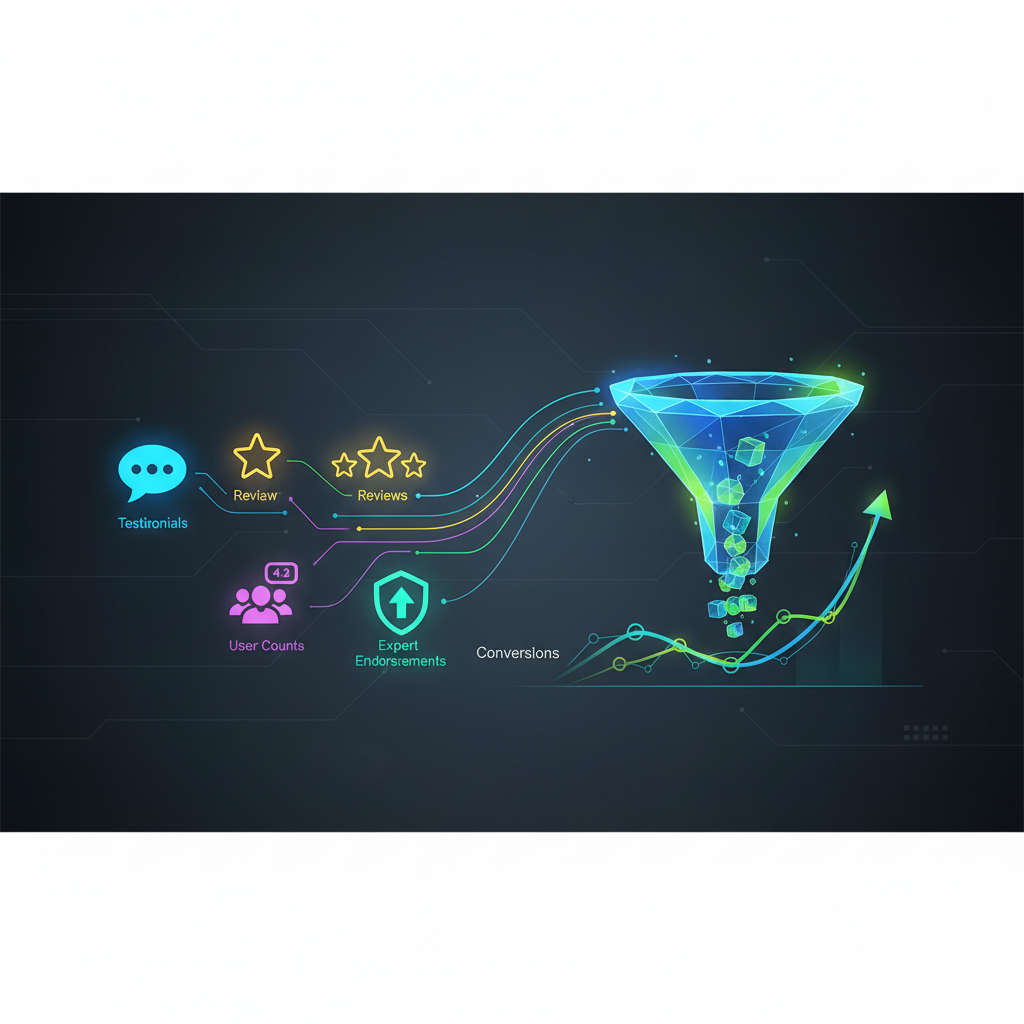
Social Proof Marketing Strategy For Higher Conversions In 2026
A robust social proof marketing strategy is essential for businesses aiming to boost their conversion rates in today’s competitive digital landscape. Social proof, fundamentally, is the psychological phenomenon where people assume the actions of others in an attempt to reflect correct behavior for a given situation. By effectively showcasing positive experiences and endorsements from existing customers, businesses can build trust, reduce perceived risk, and guide potential buyers toward making a purchase. This article explores advanced social proof tactics, from leveraging testimonials in digital ads to employing AI for curated content, all designed to significantly elevate your conversion performance.
How to Use Testimonials, Reviews, and Social Proof in Digital Ads for Maximum Impact
To maximize impact in digital advertising, integrate testimonials reviews and social proof in digital ads by showcasing genuine customer feedback directly within your ad creatives and copy. This approach immediately builds credibility and trust with potential customers who are encountering your brand for the first time. Effective use of social proof can significantly lower customer acquisition costs and improve ad click-through rates.

Crafting Compelling Ad Copy with Customer Endorsements
When developing ad copy, incorporate specific, benefit-driven quotes from customer testimonials. Instead of generic praise, highlight how your product or service solved a particular problem for a previous customer. For instance, an ad might state, “Our CRM streamlined our sales process by 30%, saving us countless hours weekly!” – a direct quote from a satisfied user. This specificity resonates more deeply with prospects facing similar challenges.
* Video Testimonials: Short, authentic video clips of customers sharing their positive experiences can be incredibly powerful. These videos humanize your brand and make the social proof feel more genuine.
* Star Ratings: Visually display high star ratings (e.g., 4.8/5 stars) prominently in your ad creatives. This provides an immediate, quantifiable measure of customer satisfaction.
* User-Generated Content (UGC): Encourage customers to share their experiences using your product on social media. Then, with their permission, repurpose this authentic content into your digital ads. UGC often outperforms professionally produced content in terms of engagement and trust.
A/B Testing Social Proof Elements in Ad Campaigns
Successful digital advertising relies heavily on continuous optimization, and this extends to your social proof elements. Regularly A/B test different types of social proof within your ad campaigns to identify what resonates most with your target audience.
Consider these testing variables:
1. Type of Social Proof: Compare ads featuring written testimonials against those with star ratings or user counts.
2. Placement: Experiment with placing social proof in the headline versus the body copy or as a visual overlay.
3. Specific Testimonials: Test different customer quotes to see which ones generate higher engagement or conversions.
4. Visuals: A/B test ads with customer photos versus ads with product-only images to see the impact on perceived authenticity and click-through rates.
By systematically testing and refining your approach, you can pinpoint the most effective ways to leverage social proof, leading to higher ad performance and improved return on ad spend.
Implementing a Social Proof Automation Strategy for E-commerce Product Pages
An effective social proof automation strategy for ecommerce product pages involves dynamically displaying customer reviews, ratings, and purchase activity to build trust and encourage immediate purchases. This automation ensures that fresh, relevant social proof is always visible, reducing manual effort and continuously optimizing the customer journey. Automated social proof helps alleviate buyer hesitation, especially for new visitors. For more insights, check out our guide on Digital Marketing Services.

Automating Review Collection and Display
The foundation of an automated social proof strategy lies in streamlining the process of collecting and displaying customer reviews. Integrate review request emails into your post-purchase workflow, automatically sending requests a few days after a customer receives their order. Utilize e-commerce platforms or third-party apps that can automatically pull these reviews and display them on relevant product pages.
Key automation features include:
* Scheduled Review Requests: Automatically send emails or in-app notifications asking for reviews after a set period post-purchase.
* Rating Aggregation: Automatically calculate and display average star ratings based on collected reviews.
* Review Filtering: Implement AI-powered filtering to highlight the most relevant or positive reviews, or to detect and flag spam.
* Schema Markup Integration: Ensure your automated review displays include schema markup to help search engines understand and display your ratings in search results, boosting organic visibility.
Showcasing Real-Time Purchase Activity and Stock Levels
Beyond static reviews, dynamic social proof elements can significantly impact conversion rates. Implementing tools that display real-time purchase activity or low stock alerts creates a sense of urgency and validates the product’s popularity. For example, a small popup stating, “John from New York just bought this item!” or “Only 3 left in stock!” can motivate hesitant buyers.
Consider these automated displays:
* “X people are viewing this product”: Shows current interest, creating a sense of popularity.
* “Recently purchased”: Highlights recent sales, indicating product desirability and trust.
* “Low stock alerts”: Creates urgency and fear of missing out (FOMO), prompting quicker decisions.
* Wishlist Adds: Displaying “X people have added this to their wishlist” can also signal product appeal.
By automating these diverse forms of social proof, e-commerce businesses can create a continuously evolving and highly persuasive environment on their product pages, driving more conversions with minimal manual intervention.
Deploying Real-Time Social Proof Popups Strategy for Landing Page Optimization
A real-time social proof popups strategy for landing page optimization involves displaying dynamic notifications about recent customer actions, such as purchases, sign-ups, or reviews, to build immediate trust and encourage conversions. These popups provide instant validation to visitors, showing them that others are actively engaging with your brand and finding value in your offerings. This tactic is particularly effective on high-traffic landing pages where immediate action is desired.
Implementing Dynamic Activity Notifications
Dynamic activity notifications are small, non-intrusive popups that appear on your landing page, showcasing recent user actions. These can include:
* Recent Sales: “Sarah from London just purchased our Premium SEO Toolkit!”
* New Sign-ups: “25 people signed up for our free trial in the last hour!”
* Positive Reviews: “A new 5-star review for our online course just came in!”
* Download Activity: “Mark downloaded the ‘Ultimate Guide to Content Marketing’ 5 minutes ago!”
These notifications create a sense of bustling activity and popularity around your product or service. They tap into the psychological principle of “wisdom of the crowds,” where people are more likely to trust and follow the actions of a larger group. Ensure these popups are configured to appear at strategic times and locations on the page, without being overly disruptive to the user experience. You can also customize their frequency and duration to avoid visitor fatigue.
Leveraging Urgency and Scarcity with Real-Time Data
Beyond just showing activity, real-time social proof popups can effectively leverage urgency and scarcity to drive conversions. This involves displaying information that suggests limited availability or a time-sensitive opportunity.
Examples include:
* “Only 3 spots left for our webinar!” – Creates scarcity for service-based offerings.
* “Flash Sale ends in 2 hours – 15 items sold in the last 30 minutes!” – Combines urgency with recent purchase activity.
* “Our most popular package – 12 people upgraded this week!” – Highlights popularity and encourages choosing a specific tier.
When implementing these, it is crucial to maintain authenticity. Falsifying scarcity or urgency can damage your brand’s reputation. Instead, use genuine data to inform these messages. Integrating these advanced social proof tactics into your broader Digital Marketing Services can significantly amplify your overall campaign effectiveness. By showing genuine, real-time engagement, you can create a powerful psychological pull that encourages visitors to convert, transforming passive browsers into active customers.
Leveraging an AI-Curated Social Proof Content Strategy for Marketing Funnels
An AI-curated social proof content strategy for marketing funnels utilizes artificial intelligence to analyze customer data and dynamically present the most relevant and persuasive forms of social proof to individual users at each stage of their buyer journey. This personalized approach ensures that the social proof shown is highly targeted, increasing its effectiveness in moving prospects further down the funnel. AI-driven curation moves beyond generic displays to deliver hyper-relevant validation.
Personalizing Social Proof with AI for Different Funnel Stages
AI’s ability to process vast amounts of data allows for unprecedented personalization of social proof. Instead of showing the same testimonials to everyone, AI can identify patterns in user behavior, demographics, and preferences to serve up the most impactful content.
Consider these AI applications across the marketing funnel:
* Awareness Stage: AI can identify new visitors and display broad social proof, such as overall customer satisfaction ratings, brand awards, or a high number of total users. This builds initial trust and credibility.
* Consideration Stage: For users exploring product features or comparisons, AI can highlight testimonials from customers who had similar pain points or achieved specific results relevant to the user’s apparent interest. For example, if a user is looking at project management software, AI might show a testimonial from a project manager praising its collaboration features.
* Decision Stage: At the point of purchase, AI can present social proof that directly addresses common objections or reinforces confidence, such as recent purchase notifications, money-back guarantee mentions, or reviews emphasizing ease of use or excellent customer support.
Automating Content Selection for Maximum Conversion Impact
AI not only personalizes what social proof is shown but also automates how it’s selected and presented. This automation ensures that your social proof strategy is continuously optimized without constant manual intervention.
Key automation aspects include:
1. Sentiment Analysis: AI can analyze customer reviews and feedback for sentiment, automatically prioritizing positive and specific testimonials.
2. Keyword Matching: If a user searches for a specific feature, AI can pull reviews that mention that feature, making the social proof highly relevant.
3. A/B Testing and Optimization: AI algorithms can continuously A/B test different social proof messages and presentations, learning which ones perform best for various audience segments and funnel stages. This iterative optimization leads to higher conversion rates over time.
4. Dynamic Content Blocks: AI can power dynamic content blocks on your website or in emails, automatically swapping in the most effective social proof based on the user’s real-time interaction and profile.
By embracing an AI-curated social proof strategy, businesses can create a more intelligent, responsive, and ultimately more effective marketing funnel that converts prospects into loyal customers more efficiently.
Measuring and Optimizing Your Social Proof Marketing Strategy for Continuous Growth
To ensure continuous growth, it is crucial to regularly measure the impact of your social proof marketing strategy and implement data-driven optimizations. This involves tracking key metrics, analyzing user behavior, and iteratively refining your approach to maximize conversion rates and overall marketing effectiveness. Without proper measurement, even the most robust social proof efforts can fall short of their potential.
Key Performance Indicators for Social Proof Effectiveness
Measuring the success of your social proof initiatives requires focusing on specific KPIs that directly correlate with your conversion goals. These metrics provide clear insights into what is working and what needs adjustment.
Consider tracking the following:
* Conversion Rate: The most direct measure. Compare conversion rates on pages with and without social proof, or with different types of social proof.
* Click-Through Rate (CTR): For social proof integrated into ads or email campaigns, track how often users click on elements containing social proof.
* Time on Page/Engagement: Pages with effective social proof might see increased user engagement and longer time spent, indicating higher interest.
* Bounce Rate: A lower bounce rate on pages with social proof can suggest that visitors find the content more reassuring and relevant.
* A/B Test Results: Document the outcomes of A/B tests on different social proof elements to identify winning variations.
* Customer Acquisition Cost (CAC): If social proof in ads leads to higher conversion rates, your CAC should decrease.
Iterative Optimization Based on Data Analysis
Once you have collected sufficient data, the next step is to analyze it thoroughly and use those insights to inform your optimization efforts. This is an ongoing cycle of testing, learning, and refining.
Here’s a framework for iterative optimization:
1. Identify Underperforming Areas: Look for pages or campaigns where social proof is present but conversion rates are stagnant or low.
2. Formulate Hypotheses: Based on your analysis, develop hypotheses about why certain social proof elements are not performing as expected. For example, “Video testimonials are not engaging our B2B audience as much as case studies.”
3. Design A/B Tests: Create experiments to test your hypotheses. This could involve changing the type of social proof, its placement, wording, or visual presentation.
4. Implement and Monitor: Deploy your A/B tests and closely monitor the relevant KPIs.
5. Analyze Results and Act: Determine which variations performed best. Implement the winning variations permanently and use the learnings to inform future tests.
6. Gather Feedback: Supplement quantitative data with qualitative feedback through surveys or user interviews to understand the ‘why’ behind the numbers.
| Social Proof Type | Primary Benefit | Best Use Case | Key Metric to Track |
|---|---|---|---|
| Testimonials & Reviews | Builds trust & credibility | Product pages, service pages, digital ads | Conversion Rate, Average Order Value |
| Real-Time Popups | Creates urgency & FOMO | Landing pages, checkout pages | Conversion Rate, Bounce Rate |
| User-Generated Content (UGC) | Authenticity & relatable experiences | Social media, product galleries, ads | Engagement Rate, CTR |
| Expert Endorsements | Authority & industry validation | High-ticket items, B2B solutions | Lead Quality, Conversion Rate |
By maintaining a rigorous measurement and optimization process, your social proof strategy will evolve to become increasingly effective, continually driving higher conversions and supporting your business’s growth objectives.
What is social proof marketing?
Social proof marketing is a strategy that leverages the psychological phenomenon where people are more likely to trust and adopt behaviors or products that others have already validated. It involves showcasing positive customer experiences, endorsements, and popularity to influence potential buyers.
How can I use testimonials in digital ads?
To use testimonials effectively in digital ads, incorporate specific, benefit-driven quotes directly into your ad copy and creatives. Use customer photos or video snippets, display star ratings prominently, and A/B test different testimonials to see which ones resonate most with your target audience.
What is a social proof automation strategy for e-commerce?
A social proof automation strategy for e-commerce involves automatically collecting and displaying customer reviews, ratings, and real-time purchase activity on product pages. This reduces manual effort while continuously presenting fresh, relevant validation to shoppers, encouraging purchases.
Are real-time social proof popups effective for landing pages?
Yes, real-time social proof popups are highly effective for landing page optimization. They display dynamic notifications about recent customer actions like purchases or sign-ups, creating immediate trust, urgency, and a sense of activity that prompts visitors to convert.
How does AI help with social proof content?
AI helps with social proof content by curating and personalizing it for different users and stages of the marketing funnel. AI can analyze data to select the most relevant testimonials, reviews, or activity notifications, ensuring the social proof shown is highly persuasive and targeted.
What metrics should I track for social proof?
Key metrics to track for social proof effectiveness include conversion rates, click-through rates (CTR) on social proof elements, time on page, bounce rate, and the results of A/B tests. These indicators help you understand the direct impact on user behavior and conversions.
Implementing a sophisticated social proof marketing strategy is no longer optional but a fundamental requirement for achieving higher conversions. By strategically integrating various forms of social proof across your marketing channels, businesses can cultivate trust, reduce friction in the buyer journey, and ultimately drive significant growth.
Key takeaways for optimizing your social proof efforts include:
* Integrate diverse social proof: Utilize testimonials, reviews, user-generated content, and real-time activity across all touchpoints.
* Automate for efficiency: Implement systems for automated review collection and dynamic display on product and landing pages.
* Personalize with AI: Leverage artificial intelligence to deliver highly relevant social proof tailored to individual user behavior and funnel stage.
* Measure and optimize: Continuously track key performance indicators and conduct A/B testing to refine your strategy for maximum impact.
Embrace these advanced social proof tactics to transform your marketing efforts, build stronger customer relationships, and unlock your full conversion potential.