
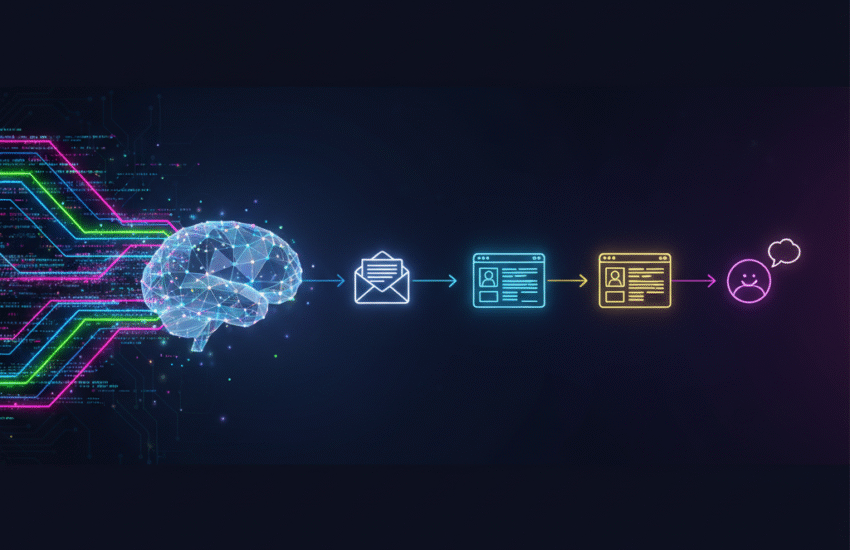
predictive personalization marketing with agentic AI systems
TL;DR: Predictive personalization AI leverages advanced agentic AI systems to anticipate customer needs and behaviors before they even express them. This enables real-time hyper personalization across all touchpoints, from email to web experiences, significantly improving conversion rates and fostering a truly personalized customer journey. By analyzing behavioral signals and predicting purchase intent, businesses can deliver highly relevant content and offers, transforming traditional marketing into a proactive, intelligent engagement strategy.
Overview
The landscape of digital marketing is undergoing a profound transformation, driven by the emergence of predictive personalization AI. This isn’t merely about segmenting audiences; it’s about anticipating individual needs and delivering tailored experiences at scale. At its core, this evolution is powered by sophisticated agentic AI marketing systems that learn, adapt, and act autonomously to optimize customer interactions.
These intelligent agents move beyond reactive responses, enabling a proactive approach to engaging consumers. They process vast amounts of data in real-time, allowing for real-time hyper personalization that was once considered impossible. The result is an unprecedented level of relevance, making every customer touchpoint feel uniquely crafted for the individual.
This shift fundamentally redefines the personalized customer experience. Instead of generic campaigns, businesses can now deploy AI driven personalization strategies that predict future actions, offering the right product or information at precisely the right moment. It’s about creating a seamless, intuitive journey that anticipates desires, fostering deeper engagement and loyalty.
The Dawn of Proactive Engagement
Traditional personalization often relies on past behavior, offering suggestions based on what a customer has already done. Predictive personalization, however, uses advanced algorithms to forecast what a customer will do. This forward-looking capability is a game-changer for marketers.
Agentic AI systems are the engine behind this proactive engagement. They continuously analyze subtle cues and complex patterns, building a dynamic profile of each user. This allows for an adaptive strategy that evolves with the customer, ensuring relevance never wanes.
In my experience, moving from rule-based personalization to an agentic AI model feels like shifting from a static map to a dynamic GPS system. The latter constantly recalculates the best route, anticipating traffic and road closures – much like AI anticipates customer needs and adjusts the marketing journey accordingly.
What is Predictive Personalization Marketing?
Predictive personalization marketing is a strategic approach that uses data, machine learning, and artificial intelligence to forecast individual customer preferences, behaviors, and future needs. It moves beyond simple segmentation to anticipate what a specific customer is likely to do next, enabling marketers to deliver highly relevant content, offers, and experiences proactively. This foresight allows businesses to engage customers more effectively and efficiently.
The core of this strategy lies in its ability to perform consumer behavior prediction. By analyzing historical data, real-time interactions, demographic information, and even external factors, AI models can identify patterns that indicate a customer’s likelihood to purchase, churn, or engage with specific content. This deep understanding allows for truly proactive interventions rather than reactive responses.
What most guides miss is that predictive personalization isn’t just about showing the right product; it’s about understanding the intent behind the interaction. It leverages purchase intent prediction AI to identify customers who are most likely to convert, even before they explicitly search for a product. This allows for targeted messaging that guides them through their decision-making process, often before competitors even register their interest.
Beyond Basic Segmentation
Traditional marketing automation often relies on broad segments, leading to experiences that are “personalized enough” but rarely truly resonant. Predictive personalization refines this by creating micro-segments or even individual profiles, driven by constantly updating data. This dynamic approach ensures that personalization remains relevant as customer needs evolve.
This advanced form of marketing automation AI integrates seamlessly across various channels, from email to website interactions. It ensures consistency in the personalized experience, regardless of where the customer engages. The goal is to create a cohesive and intuitive journey that feels natural and helpful.
For instance, a customer browsing hiking gear might receive an email about upcoming trail events, rather than just another product recommendation. This contextual relevance, driven by predictive insights, significantly enhances engagement and perceived value.
How Agentic AI Systems Enhance Personalization
Agentic AI systems represent the next frontier in marketing technology, fundamentally enhancing personalization by introducing autonomy and adaptive intelligence. Unlike traditional AI that primarily executes predefined tasks, agentic AI marketing systems can observe, learn, reason, plan, and act independently to achieve specific marketing objectives. They are designed to operate with a degree of self-sufficiency, constantly optimizing their strategies based on real-time feedback.
These intelligent agents are crucial for delivering real-time hyper personalization. They continuously process vast streams of behavioral signal marketing AI data, such as clicks, scrolls, dwell times, search queries, and even sentiment from customer service interactions. This constant influx of information allows them to update customer profiles dynamically and adjust personalization strategies on the fly, ensuring that every interaction is maximally relevant.
The true power of agentic AI lies in its ability to go beyond simple data analysis to understand context and anticipate needs. For example, an agentic AI system might detect subtle shifts in a customer’s browsing patterns that indicate a change in lifestyle, prompting it to offer relevant services or products proactively. This capability is essential for businesses looking to offer truly bespoke experiences and stay ahead of evolving customer demands. In my experience, this level of dynamic adaptation is what truly differentiates leading brands in competitive markets.
The Mechanism of Dynamic Adaptation
Agentic AI systems employ sophisticated machine learning models to build rich, evolving customer profiles. These profiles are not static; they continuously update based on new interactions and inferred preferences. This dynamic learning process allows the AI to refine its understanding of each individual over time.
Consider a scenario where a customer frequently browses travel destinations. An agentic AI might observe a sudden increase in searches for family-friendly resorts. It could then infer a shift in travel intent, perhaps due to a new family addition, and adjust future recommendations accordingly, offering relevant packages and activities.
This deep level of understanding is critical for how agentic AI delivers real-time hyper personalization. It allows for granular control over the customer journey, ensuring that every piece of content, every offer, and every interaction is precisely tuned to the individual’s current state and predicted future needs. To explore how such advanced capabilities can transform your business, consider our next-gen Digital Marketing services.
Key Benefits of Using AI Agents for Marketing
The integration of AI agents into marketing strategies unlocks a multitude of benefits, most notably in improving conversion rates with predictive AI. By precisely anticipating customer needs and delivering highly relevant experiences, these systems significantly increase the likelihood of a purchase or desired action. This isn’t just about incremental gains; it’s about a fundamental shift in marketing effectiveness, driving substantial ROI.
Furthermore, AI agents are instrumental in crafting an unparalleled personalized customer experience. They ensure that every interaction, whether on a website or through email, feels tailor-made. This consistent relevance builds stronger customer relationships, fostering loyalty and reducing churn. Customers feel understood and valued, leading to increased satisfaction and repeat business.
The operational efficiency gained through AI agent deployment is also substantial. These systems automate complex personalization tasks, freeing up marketing teams to focus on strategic initiatives rather than manual segmentation and content delivery. This scalability allows businesses to offer sophisticated personalization to millions of customers simultaneously, something impossible with traditional methods.
Enhanced Engagement Across Channels
One of the most powerful applications is AI agent email personalization. Instead of sending generic newsletters, AI agents can dynamically craft email content, subject lines, and send times based on individual recipient behavior and predicted engagement. This leads to significantly higher open rates and click-through rates.
Similarly, AI web personalization transforms static websites into dynamic, interactive platforms. AI agents can adjust website layouts, recommend products, display personalized offers, and even alter navigation paths in real-time, based on a visitor’s current behavior and predicted interests. This creates a highly engaging and intuitive browsing experience.
The overlooked factor here is the cumulative effect of these personalized touchpoints. When a customer experiences consistent, relevant interactions across email, web, and other channels, their overall perception of the brand elevates dramatically. This consistent excellence is a direct benefit of agentic AI in marketing.
Implementing Predictive Personalization with AI Agents: An Action Framework
Successfully implementing predictive personalization with AI agents requires a structured approach, moving beyond theoretical understanding to practical application. It’s a journey that begins with data and culminates in dynamic, intelligent customer engagement.
1. Data Foundation & Integration: Start by consolidating all available customer data from various sources – CRM, website analytics, email platforms, social media, and transactional systems. Ensure data quality and establish robust integration pipelines. This comprehensive view is the bedrock for accurate predictions and AI powered customer segmentation strategies.
2. Define Personalization Objectives: Clearly articulate what you aim to achieve. Are you focused on increasing conversion rates, reducing churn, improving customer lifetime value, or enhancing cross-selling? Specific objectives will guide the selection and training of your AI models.
3. Select & Train Agentic AI Models: Choose AI platforms capable of agentic behavior, which can learn, adapt, and act autonomously. Train these models using your integrated data to recognize patterns, predict behaviors, and understand purchase intent prediction before consumer searches. This phase is iterative and requires continuous refinement.
4. Channel Integration & Deployment: Integrate the AI agents across your key marketing channels, including your website for AI web personalization and email for AI agent email personalization. Ensure seamless deployment so that personalized experiences are delivered consistently and in real-time.
5. Monitor, Test & Optimize: Predictive personalization is not a set-it-and-forget-it strategy. Continuously monitor performance metrics, conduct A/B tests on different personalization strategies, and use the insights to retrain and optimize your AI models. This iterative process is crucial for maximizing effectiveness.
Overcoming Implementation Challenges
The biggest challenge often lies in data silos. Many organizations have valuable customer data scattered across disparate systems, making it difficult to create a unified view. Investing in a robust Customer Data Platform (CDP) can significantly streamline this process.
Another hurdle is the initial investment in AI talent and technology. However, the long-term gains in efficiency and conversion rates typically far outweigh these upfront costs. What most guides miss is the importance of starting small, perhaps with one channel, and scaling up as you gain expertise and demonstrate ROI.
Finally, ensuring ethical data use and transparency with customers is paramount. Building trust is non-negotiable when leveraging advanced AI for personalization.
The Role of Real-Time Behavioral Signals in AI Personalization
Real-time behavioral signal marketing with AI agents is the engine that drives truly dynamic and responsive personalization. These signals are the immediate digital footprints customers leave as they interact with your brand, encompassing everything from website clicks and scroll depth to search queries, product views, and even the time spent on a particular page. AI agents are uniquely equipped to capture, interpret, and act upon these transient yet powerful cues instantly.
The ability of AI agents to process these signals in milliseconds allows for real-time hyper personalization. Imagine a customer browsing a specific product category on your website. An agentic AI system can immediately identify this interest, cross-reference it with past behavior and predicted preferences, and then dynamically adjust the website content, recommend complementary products, or even trigger a personalized pop-up offer. This immediate responsiveness significantly enhances the relevance of the interaction.
These behavioral signals also provide critical insights for purchase intent prediction before consumer searches. By analyzing patterns like repeated visits to product pages, adding items to a cart without purchasing, or comparing specific features, AI can infer a strong buying signal. This allows marketers to intervene proactively with targeted messaging or incentives, nudging the customer towards conversion before they even consider searching for alternatives.
From Data Points to Actionable Insights
Every click, every scroll, every interaction is a data point. Agentic AI transforms these raw data points into actionable insights by understanding the context and sequence of behaviors. It’s not just what a customer does, but why and what it implies for their next likely action.
For example, a sudden drop-off in engagement after viewing a pricing page could trigger an AI agent to offer a limited-time discount via email. Conversely, sustained engagement with educational content might prompt the AI to recommend a relevant webinar or whitepaper, nurturing the customer further down the funnel.
This continuous feedback loop, where AI agents observe, learn, and adapt based on real-time signals, is what makes predictive personalization so powerful. It creates an ever-evolving, highly responsive customer journey that maximizes engagement and drives measurable results.
Data-Backed Insights on Predictive Personalization
* 71% of consumers expect companies to deliver personalized interactions. This highlights the imperative for businesses to adopt advanced personalization strategies like predictive AI, as customer expectations have significantly risen beyond generic approaches.
* Companies using advanced personalization see a 20% increase in sales. This demonstrates a clear correlation between sophisticated personalization and direct revenue growth, underscoring the commercial benefits of investing in predictive AI.
* AI-driven personalization can reduce customer acquisition costs by up to 50%. By targeting the right customers with the right message at the right time, AI minimizes wasted marketing spend and optimizes resource allocation.
* Personalized calls to action convert 202% better than generic CTAs. This emphasizes the power of tailored messaging, which agentic AI systems excel at creating based on individual user data and predicted intent.
* 80% of consumers are more likely to make a purchase from a brand that provides personalized experiences. This statistic reinforces the direct link between personalization and consumer purchasing behavior, making predictive personalization a critical driver for sales.
Comparison: Traditional vs. Agentic AI Personalization
| Feature | Traditional Personalization | Agentic AI Personalization |
|---|---|---|
| Data Processing | Batch processing, static segments | Real-time, dynamic individual profiles |
| Decision Making | Rule-based, human-defined logic | Autonomous learning, adaptive algorithms |
| Responsiveness | Reactive, delayed | Proactive, instantaneous (real-time hyper personalization) |
| Complexity | Simpler, often limited to basic attributes | Highly complex, nuanced behavioral signals |
| Scalability | Limited by manual oversight | Highly scalable, automates at individual level |
| Outcome | “Personalized enough” experiences | Hyper-relevant, anticipatory customer journeys |
Ethical Considerations and the Future of Personalized Marketing with AI
As we embrace the power of predictive personalization with AI agents, it’s crucial to address the ethical considerations of AI personalization. The ability to anticipate and influence consumer behavior comes with a significant responsibility. Transparency in data collection and usage, ensuring data privacy, and avoiding manipulative practices are paramount. Brands must strive for a balance between highly effective personalization and respecting customer autonomy. Building trust through clear communication about how data is used for their benefit is key to long-term success.
The future of personalized marketing with AI is undoubtedly agentic, moving towards increasingly autonomous and sophisticated systems. We will see AI agents not only predicting needs but also actively co-creating experiences with consumers, offering personalized recommendations that feel like genuine assistance rather than targeted advertising. This evolution will further blur the lines between marketing and customer service, creating a seamless, supportive brand interaction.
In my prediction, the next wave will involve federated learning, where AI agents collaborate across different platforms and brands (with explicit user consent) to offer an even more holistic and context-aware personalization. This would mean a truly unified customer experience that anticipates needs across various aspects of a consumer’s life, from health and wellness to entertainment and finance. The key will be maintaining user control and ensuring ethical boundaries are never crossed.
Practical Checklist for Adopting Predictive Personalization AI
* Audit Your Data Infrastructure: Identify all customer data sources and assess their quality. Prioritize unifying disparate data into a single, accessible platform.
* Define Clear Personalization Goals: What specific business outcomes do you want to achieve with predictive personalization? Quantifiable goals are essential.
* Invest in Agentic AI Capabilities: Research and select AI platforms or partners that offer true agentic capabilities, not just basic automation.
* Start with a Pilot Program: Begin implementing predictive personalization in a specific channel or for a defined customer segment to learn and iterate.
* Establish Robust A/B Testing Protocols: Continuously test different personalization strategies to understand what resonates best with your audience.
* Prioritize Data Privacy & Transparency: Ensure your data practices are compliant with regulations and communicate clearly with customers about how their data enhances their experience.
* Train Your Team: Equip your marketing and data teams with the skills to work with AI agents, interpret insights, and manage advanced personalization strategies.
* Monitor Performance Metrics Rigorously: Track key performance indicators (KPIs) related to engagement, conversions, and customer satisfaction to measure ROI.
* Plan for Iterative Optimization: Recognize that predictive personalization is an ongoing process of learning and refinement, not a one-time setup.