
You checked clicks.
You checked impressions.
You checked average position.
You opened Google Search Console and asked the same question every month:
“Which pages are bringing us traffic?”
That question is still important.
But content discovery has changed.
Brands, creators, publishers, SaaS companies, ecommerce businesses, and personal brands now publish across websites, Instagram, TikTok, X, and YouTube. A customer might discover your website through Google, watch your YouTube video from a search result, find an Instagram post, or search your brand after seeing a TikTok.
Google has now expanded Search Console to help you understand that wider search visibility.
On July 7, 2026, Google announced Platform Properties, a new Search Console property type that lets creators and publishers track how content published on Instagram, TikTok, X, and YouTube is discovered through Google Search and, where applicable, Discover and Google News. Google subsequently announced on July 29 that Platform Properties had become globally available.
That changes the conversation around SEO.
Your website is no longer the only digital asset that can generate search visibility.
Your social posts and videos can become part of your Google discovery strategy too.
And that creates a very interesting opportunity for businesses that are serious about SEO, social media marketing, video marketing, YouTube SEO, content strategy, and generative search visibility.
Let’s break down exactly what Google launched, what you can measure, why it matters, and how your marketing team can use the data to build a smarter content strategy.
What Is Google Search Console Platform Properties?
Platform Properties are a new type of Google Search Console property designed to help you monitor the performance of content published on supported social and video platforms.
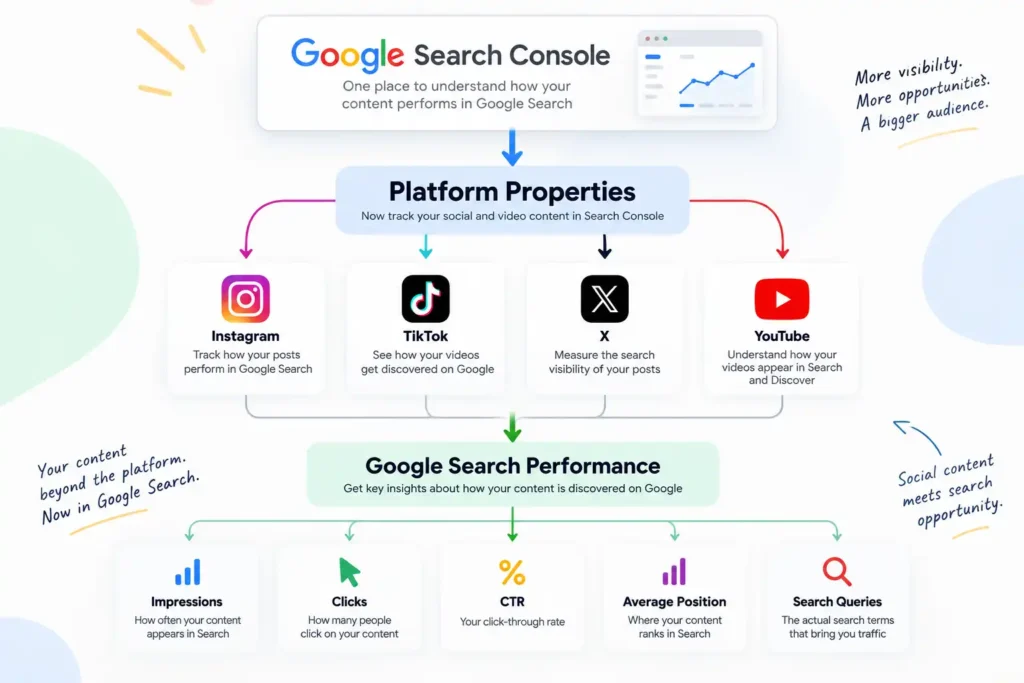
Instead of limiting Search Console reporting to a website, Google now allows you to connect eligible accounts on:
- TikTok
- X
- YouTube
Once you connect a supported platform account or channel, Search Console can show how that content performs when users discover it through Google.
This is an important distinction:
Google is not giving you a complete analytics dashboard for Instagram, TikTok, X, or YouTube.
It is specifically showing you how your content performs inside Google’s search ecosystem.
For example, Search Console can help answer questions such as:
Which Google searches are sending users to my YouTube videos?
Which Instagram posts are getting discovered in Google Search?
Which social content is earning impressions from Google?
Which posts are generating clicks from search?
Which topics are starting to trend in Google?
That information can become extremely useful when you connect your SEO strategy with your social and video strategy.
Why This Search Console Update Matters for Digital Marketing
Here’s the bigger shift.
For a long time, many marketing teams treated SEO and social media as separate channels.
SEO lived in:
Google Search Console + GA4 + website analytics
Social lived in:
Instagram Insights + TikTok Analytics + LinkedIn Analytics + YouTube Studio
Video lived somewhere else.
Paid campaigns lived in ad managers.
The result?
A lot of fragmented data.
Your SEO team might know which keywords are growing.
Your social media manager might know which Reels are getting engagement.
Your YouTube manager might know which videos are getting views.
But the bigger question often remained unanswered:
“Which of our content assets are actually being discovered through Google?”
Platform Properties start closing that visibility gap.
Google says the new reporting includes performance information such as clicks, impressions, CTR, average position, search queries, and content performance, depending on the report and platform.
That means your marketing team can begin looking at social and video content through a search-intent lens.
And that is where things get interesting.
How Google Search Console Platform Properties Work
Setting up a Platform Property is designed to be relatively straightforward.
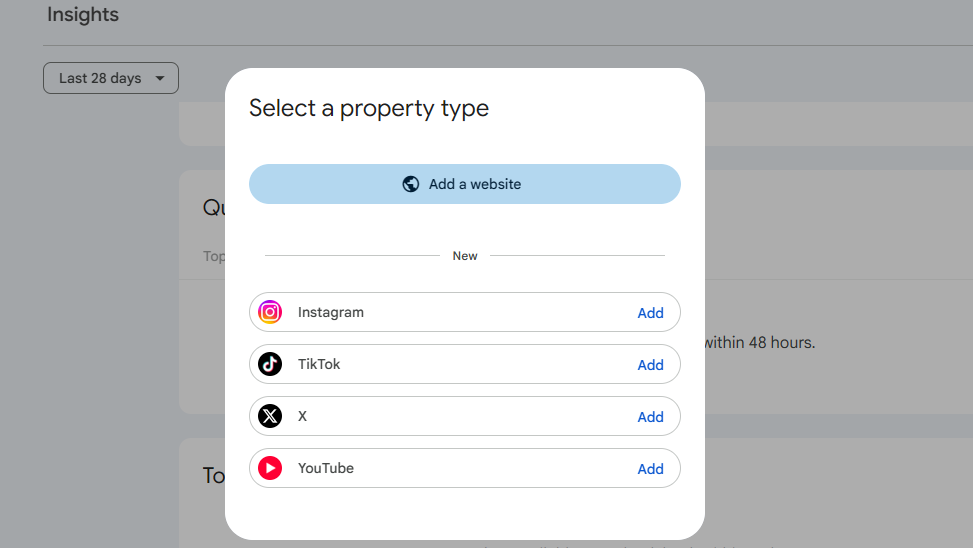
Inside Google Search Console, you can add a property and select one of the supported platforms.
Google currently supports:
Instagram, TikTok, X, and YouTube.
You then follow Google’s verification or connection flow to confirm ownership of the account or channel.
Once your property is connected, Google says it can take a few days for data to appear in reports.
If you manage multiple social accounts or channels, each one can be tracked independently.
That matters for agencies and enterprise marketing teams because you may have:
- Multiple YouTube channels
- Multiple Instagram accounts
- Different regional social profiles
- Product-specific channels
- Brand and executive profiles
- Separate content properties for different business units
You can therefore begin thinking beyond:
“How did my website rank?”
and toward:
“How is my entire content ecosystem being discovered through Google?”
What Can You Track with Google Search Console Platform Properties?
This is where the update becomes particularly useful for SEO professionals.
Google has introduced multiple reporting areas around platform performance.
1. Performance Report
The Performance report helps you understand how your platform content is performing in Google Search.
According to Google, you can view metrics including:
- Clicks
- Impressions
- CTR
- Average position
- Search queries
You can also filter and sort data to understand which posts and queries are driving the most search traffic. Data can also be exported for deeper analysis.
This creates a new layer of keyword research.
Imagine you run a B2B SaaS company.
You publish a YouTube video targeting:
“How to automate employee workflows”
A few weeks later, Search Console shows that people are discovering that video through variations such as:
- employee workflow automation
- workflow automation tools
- how to automate business workflows
- workflow automation for teams
Those searches are more than performance metrics.
They are content intelligence.
They tell you what your audience is actually searching for.
2. Insights Report
Google also introduced an Insights report to provide a more accessible snapshot of content performance and traffic trends.
Google says Insights can highlight:
- Recent traffic trends
- Top-performing posts
- How users discover your account through Google Search
- Trending query groups
Google’s July 29 update specifically highlighted using these query trends to identify what audiences care about and inform future video topics, captions, hashtags, and content ideas.
This is a powerful concept for content marketers.
Instead of brainstorming your next 20 social posts based on assumptions, you can use search behavior to inform what you create next.
That is the difference between:
“What should we post?”
and
“What is our audience already searching for?”
3. Achievements
Search Console has also added an Achievements section for milestones such as reaching new click thresholds from Google Search over a recent 28-day period.
On its own, that might not transform your strategy.
But it can make search performance easier to communicate internally.
Instead of handing leadership a spreadsheet full of numbers, you can identify clear progress markers and use them alongside more meaningful business KPIs.
For example:
Search clicks increased → content visibility improved → qualified discovery increased → assisted conversions can be investigated.
The real value still comes from connecting search data to your wider funnel.
The Biggest Opportunity: Your Social Content Is Now Part of Your SEO Data
This is probably the most important takeaway from the update.
Your Instagram content is no longer something you should necessarily think of as existing only inside Instagram.
Your YouTube videos aren’t necessarily confined to YouTube.
Your TikTok content can potentially be discovered through Google.
Your X posts can appear in search.
Google’s Platform Properties help you measure that discovery.
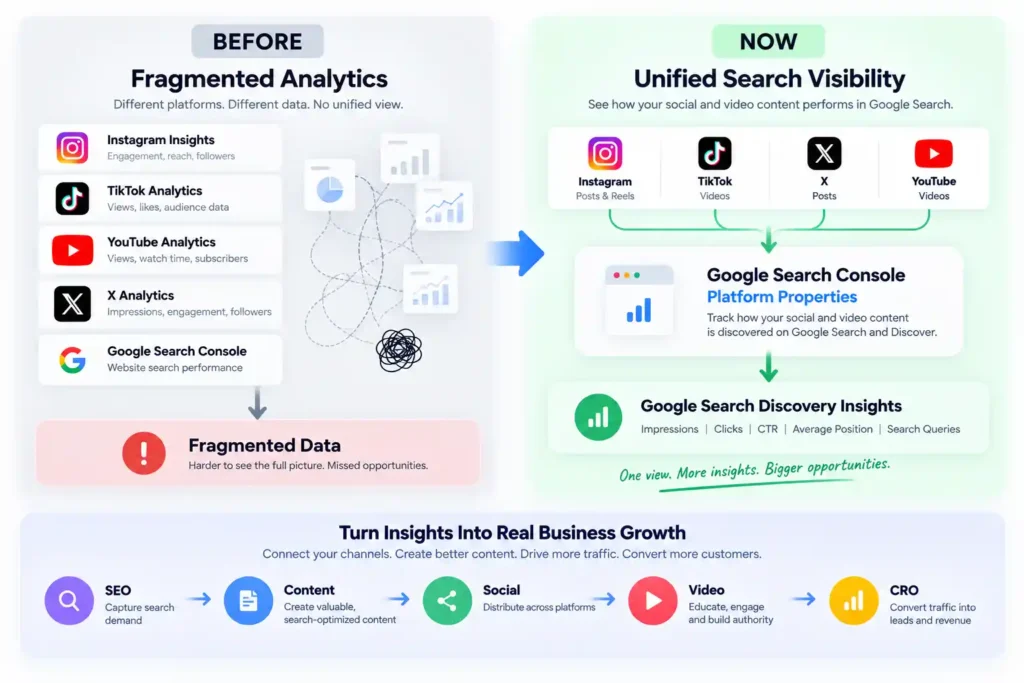
That creates a more connected way to think about search engine optimization and social media content strategy.
Consider a simple funnel.
Someone searches Google.
They discover your YouTube video.
Then they visit your website.
Then they search your brand name again.
Then they follow your Instagram account.
Then they eventually become a lead.
Traditional reporting may struggle to tell that complete story.
Platform Properties don’t solve attribution across the entire customer journey, but they give marketers more visibility into an important part of it:
How social and video content gets discovered through Google.
What Does This Mean for YouTube SEO?
This update is especially interesting for brands investing in YouTube SEO and video marketing.
YouTube has always had its own internal discovery system, but Google Search can also surface video content.
Now you can use Search Console data to investigate which search queries are associated with your videos when those videos appear in Google.
That creates a useful feedback loop:
Search query → video visibility → clicks → topic validation → new video opportunity
For example, suppose you publish:
“How to Create a B2B Lead Generation Funnel”
You might discover that users are also searching for:
- B2B lead generation funnel examples
- B2B lead generation strategy
- how to generate B2B leads
- B2B funnel for SaaS
- B2B demand generation funnel
Now you have more than one video idea.
You potentially have:
- A YouTube series
- Supporting blog content
- LinkedIn posts
- Short-form video clips
- FAQ content
- Landing page sections
- Email content
One search insight can turn into an entire content cluster.
That is how SEO and content marketing compound.
How to Use Search Console Data to Find Your Next Content Ideas
This is where smart marketers can get ahead.
Don’t just look for the post with the highest clicks.
Look for patterns.
Suppose your data reveals that several of your videos are being discovered around the broader topic:
“CRM automation for small businesses.”
That immediately gives you multiple content opportunities.
You could create:
YouTube video:
How to Automate Lead Follow-Ups for a Small Business
Blog:
CRM Automation for Small Businesses: Complete Guide
LinkedIn post:
5 CRM Follow-Up Automations Every Sales Team Should Have
Instagram carousel:
7 Leads You’re Losing Because Your Follow-Up Is Too Slow
Landing page:
CRM Automation Services for Growing Businesses
This is where search data turns into an actual content engine.
Not random posting.
Not “let’s post three times this week.”
A connected strategy based on demand.
Can Social Media Content Now Rank on Google?
Yes, social and video content can appear in Google Search when Google determines it is relevant and eligible to show.
But you should not interpret the new Search Console feature as a guarantee that every post will rank.
Google’s documentation makes the distinction clear: Platform Properties report how your content performs on Google Search, but they do not measure everything happening inside the social platform itself. For example, they don’t tell you how many people saw a TikTok on TikTok itself.
That distinction matters.
Your Instagram analytics might tell you:
100,000 views
while Search Console could show:
2,500 Google impressions
Those numbers are not contradictory.
They measure different discovery environments.
One measures platform activity.
The other measures Google visibility.
Google Search Console for Instagram and TikTok: Why Marketers Should Pay Attention
Instagram and TikTok are often treated primarily as discovery and engagement platforms.
But search behavior is increasingly influencing how people find information across the web.
This means marketers should consider search intent when creating social content.
Instead of only asking:
“Will this get likes?”
also ask:
“Does this answer something people search for?”
That small shift can change your content strategy.
Instead of creating a generic Reel:
“3 Marketing Tips”
you could create:
“3 SEO Mistakes SaaS Companies Make When Launching a New Website”
Instead of:
“Marketing trends you need to know”
you could create:
“How AI Search Is Changing SEO for B2B SaaS Companies”
The second version gives Google more meaningful context around the topic.
Your social content becomes more searchable, more specific, and more aligned with user intent.
Platform Properties and Generative AI Search
There is another reason this update matters.
Search is no longer limited to the classic blue-link experience.
People increasingly ask AI systems questions and expect synthesized answers.
That means brands need to think beyond traditional rankings.
You need content that is:
- Discoverable
- Understandable
- Topically relevant
- Consistent across channels
- Easy to interpret
- Strongly connected to your brand
This is where AEO (Answer Engine Optimization) and Generative Engine Optimization (GEO) become increasingly relevant.
A video, Instagram post, blog, LinkedIn post, or other content asset can contribute to the overall digital footprint around a topic.
The goal should not be:
“How do I game AI?”
The better question is:
“How do I consistently publish useful, original information that search engines and answer systems can understand?”
That starts with strong information architecture, clear topic coverage, entity consistency, useful content, and real expertise.
Platform Properties don’t magically make social content appear in AI answers.
But they give marketers another signal about how Google is discovering and surfacing content across platforms.
And that makes them useful for a broader SEO + content + AEO strategy.
How Enterprise Marketing Teams Can Use Platform Property Data
For an enterprise brand, this could become particularly valuable.
Imagine your company manages:
- 3 YouTube channels
- 5 Instagram accounts
- 2 TikTok profiles
- 4 X accounts
- Multiple websites
Previously, social search visibility could be difficult to consolidate.
Now, you have a Google Search Console framework for examining supported platform properties.
This means your marketing team can potentially compare:
Which channels earn Google impressions?
Which topics drive clicks?
Which content formats perform?
Which queries are rising?
Which posts are losing momentum?
Google’s July 29 guidance also recommends exporting data from multiple properties into a spreadsheet so teams can compare content performance across YouTube, Instagram, X, and TikTok.
That can turn scattered content reporting into a much more strategic process.
Don’t Just Track Traffic. Track Content Patterns.
Here’s the mistake I would avoid.
Opening Search Console once a month and asking:
“How many clicks did we get?”
That is too shallow.
Instead, look for patterns across:
Queries
What language does your audience actually use?
Topics
Which themes repeatedly generate visibility?
Content
Which posts or videos are attracting search traffic?
Trends
Which topics are accelerating?
Formats
Are long-form videos outperforming Shorts for search discovery?
Relevance
Does your content answer the exact intent behind the query?
Google’s own guidance suggests using trending query groups, recent traffic spikes, older content regaining search traction, and comparisons between different content formats to guide content decisions.
That’s much more actionable than a vanity-metric report.
A Simple Search-Driven Social Content Workflow
Here’s a practical framework you can implement.
Step 1: Connect Your Platform Properties
Add your eligible Instagram, TikTok, X, and YouTube accounts to Search Console.
Complete verification and allow the reports to populate. Google notes that data can take a few days to appear after setup.
Step 2: Find Your Top Search Queries
Look for the queries associated with your content.
Don’t just focus on high-volume terms.
Look for:
- Commercial intent
- Problem-based searches
- Comparison searches
- How-to queries
- Industry-specific questions
- Emerging topics
Step 3: Build Content Clusters
Turn one successful query into multiple content assets.
One topic can become a:
Blog + YouTube video + LinkedIn post + Instagram carousel + TikTok + email
Step 4: Refresh Existing Content
If an older video or post starts gaining Google search traction again, don’t ignore it.
Google specifically recommends using these signals to determine whether older content should be updated, pinned, expanded, or turned into a follow-up piece.
Step 5: Test Titles, Captions & Topics
Google’s new social and video performance guidance even highlights using annotations to understand whether changes such as rewriting a YouTube title or TikTok caption affect search performance over time.
This is where SEO becomes experimentation.
Test.
Measure.
Learn.
Repeat.
What About Discover and Google News?
Platform Properties aren’t limited exclusively to standard Google Search.
Google says the new property type can also provide reporting for Discover and Google News where applicable.
That creates another potential discovery surface for publishers and creators.
But remember:
Eligibility and actual appearance depend on Google’s systems and the content itself.
You shouldn’t build a strategy around guaranteed Discover or Google News exposure.
Build useful content first.
Then measure where Google actually surfaces it.
What Platform Properties Do NOT Track
This part is important.
Platform Properties don’t replace:
Instagram Insights
TikTok Analytics
YouTube Analytics
X Analytics
They answer a different question.
Google says Platform Properties focus on how your content performs on Google Search, rather than how it performs natively inside the platform.
So you still need your native platform analytics.
Think of your reporting stack like this:
Native platform analytics → platform engagement
Search Console → Google discovery
GA4 → website behavior
CRM → pipeline and revenue
The real value comes from connecting these systems rather than choosing one.
How This Changes SEO Strategy in 2026
SEO is becoming less about a single website ranking for a list of keywords.
Your brand can have multiple searchable assets:
Website pages
YouTube videos
Instagram posts
TikTok videos
X posts
News coverage
Community content
Third-party mentions
That creates a much broader search presence.
Your SEO strategy should therefore increasingly ask:
“What does Google understand about our brand across the entire web?”
not only:
“Which page ranks for this keyword?”
That is an important strategic distinction.
Should You Change Your Social Media Strategy Because of This Update?
Not completely.
But you should make it smarter.
Your social strategy should still prioritize:
Attention.
Engagement.
Community.
Brand building.
But now you have another reason to create content around real questions and search intent.
The strongest content often sits at the intersection of:
What your audience wants to know
What your audience wants to watch
What your business wants to be known for
That is where SEO, social media, video marketing, and brand strategy start working together.
How Marketing Miniac Can Help You Turn Search Data Into Growth
This is exactly where fragmented marketing creates a problem.
One team handles SEO.
Someone else handles social.
Another person runs paid ads.
Someone creates videos.
And nobody owns the whole funnel.
At Marketing Miniac, we approach digital growth as a connected system.
Our existing service ecosystem covers areas including Organic Growth & SEO, Paid & Performance, Web Development & CRO, Retention & Automation, and Creative & Strategy.
That matters because search visibility alone isn’t enough.
You need to turn attention into action.
You may need:
SEO to capture high-intent searches.
Content marketing to build topical authority.
YouTube SEO to capture video discovery.
Social media marketing to build attention and trust.
CRO to turn traffic into enquiries or sales.
Marketing automation to follow up when prospects aren’t ready to buy.
And that’s where the bigger growth engine appears.
👉 Explore Marketing Miniac’s digital marketing services
Don’t Ignore the Data Your Content Is Already Generating
Your next winning content idea might already be sitting inside Search Console.
The question is whether you’re looking for it.
Maybe an old YouTube video has suddenly started receiving search impressions.
Maybe an Instagram post is being discovered for a question you haven’t targeted on your website.
Maybe users are searching for a topic that your competitors haven’t created strong content around yet.
Those are opportunities.
Don’t let them become another spreadsheet nobody opens.
Turn the insight into:
a new article.
a new video.
a new landing page.
a new campaign.
a new content cluster.
That’s how you turn search data into an actual growth strategy.
Final Takeaway: Google Is Giving Marketers a Bigger View of Search
Google Search Console has traditionally been one of the most important tools for understanding website search performance.
Now, Platform Properties expand that picture.
You can use Search Console to understand how supported content from Instagram, TikTok, X, and YouTube is discovered through Google Search, with additional reporting for Discover and Google News when applicable. Google announced the feature on July 7, 2026, and confirmed global availability on July 29, 2026.
The takeaway isn’t that every social post suddenly becomes an SEO asset.
The takeaway is more useful:
Your content ecosystem is becoming more interconnected.
Search data can now help you understand what social and video content Google surfaces.
That data can influence what you publish next.
And when SEO, social, video, CRO, and automation work together, your marketing stops looking like a collection of disconnected channels.
It starts looking like a growth system.
Ready to Turn Search Visibility Into Revenue?
You don’t need more random posts.
You need a strategy that connects search intent, content, social distribution, conversion optimization, and measurable growth.
Marketing Miniac builds digital marketing systems designed to attract attention, capture demand, convert visitors, and scale what works.
👉 Explore Our Digital Marketing Services
Already have traffic but aren’t happy with your conversion rate?
👉 Learn how strategic CTA placement can improve service-page conversions
Planning an ongoing marketing engagement and trying to understand agency pricing?
👉 Read our guide to digital marketing retainer pricing
Or skip the rabbit hole and talk to the team directly.
Your audience is already searching. The question is whether your brand is ready to be found.
Frequently Asked Questions About Google Search Console Platform Properties
1. What are Google Search Console Platform Properties?
Google Search Console Platform Properties let you track how your Instagram, TikTok, X, and YouTube content performs in Google Search. You can create a separate property for each supported account or channel and use Search Console to see search visibility, clicks, impressions, queries, and other performance data.
This gives you a better view of how your social media and video content gets discovered through Google, instead of relying only on native platform analytics.
2. Can I use Google Search Console to track Instagram posts in Google Search?
Yes. You can add an eligible Instagram account as a Search Console Platform Property and monitor how its content performs in Google Search. Google also provides post-level and query-related performance information so you can understand how people discover your Instagram content through search.
This can help you identify topics and search queries worth using in future Instagram posts, captions, carousels, and Reels.
3. Can Google Search Console track TikTok videos and TikTok search traffic?
Yes. TikTok is one of the four platforms currently supported by Google Search Console Platform Properties. You can connect your TikTok presence and analyze how your TikTok content is discovered through Google Search.
For marketers, this creates a useful connection between TikTok content strategy, SEO keyword research, and Google search visibility.
4. Can I track YouTube videos in Google Search Console?
Yes. YouTube is supported as a Platform Property in Google Search Console. You can analyze how your YouTube content performs when users discover it through Google Search and, where applicable, Discover or Google News.
This makes Search Console useful alongside YouTube Analytics when you’re working on a YouTube SEO strategy.
5. Does Google Search Console now track X posts in Google Search?
Yes. X is supported by Search Console Platform Properties, allowing you to examine how your X content is discovered through Google Search.
You can use this data to understand which topics and search queries are bringing visibility to your posts and use those insights to guide future content.
6. What SEO metrics can I see for Instagram, TikTok, X, and YouTube?
The Search Console Performance report can provide metrics such as clicks, impressions, click-through rate (CTR), and average position. You can also filter performance to understand which posts and search queries generate traffic.
That makes it possible to move beyond vanity metrics and ask a more useful question:
Which content is actually earning visibility and clicks from Google?
7. Can I see which Google searches are driving traffic to my social media posts?
Yes. One of the most useful features of Platform Properties is the ability to see search terms and query groups associated with your social and video content in Google Search.
For example, your YouTube video might unexpectedly receive search visibility for a long-tail query such as “how to automate lead follow-ups for a small business.”
That insight can help you create another video, blog post, LinkedIn post, or landing page around the same search intent.
8. Does Google Search Console show Instagram and TikTok views from inside those apps?
No. Platform Properties focus on how your content performs on Google, not its complete performance inside Instagram, TikTok, X, or YouTube.
Your native platform analytics still matter for metrics such as platform-specific views, engagement, followers, watch time, and audience behavior.
Think of it this way:
Native analytics = performance inside the platform
Search Console = Google Search discovery
Using both gives you a much more complete picture.
9. How can I use Google Search Console Platform Properties for SEO keyword research?
You can use the search queries associated with your social and video content to uncover real-world long-tail keywords, conversational searches, and emerging topics.
Suppose several videos begin getting impressions for:
“best CRM automation for small businesses”
You could use that insight to create:
- A detailed SEO article
- A CRM service page
- A YouTube video
- A LinkedIn post
- An Instagram carousel
- An FAQ section
- A comparison page
This turns search performance data into a cross-channel content strategy rather than treating every platform separately.
10. Can Search Console help me find ideas for my next YouTube video?
Yes. Google specifically recommends using query trends from Platform Properties to understand what audiences care about and use those insights for future video topics, captions, and hashtag strategies.
For example, if search data shows growing interest around “how to improve Google Ads ROAS,” you could create a video targeting that exact problem rather than publishing another broad “Google Ads Tips” video.
That makes your content more closely aligned with search intent.
11. How can I use Search Console to improve my social media content strategy?
Look for three things:
What is gaining visibility?
Identify posts and videos attracting Google impressions and clicks.
What are people searching for?
Look for recurring topics, long-tail queries, questions, and emerging search themes.
What can you build next?
Turn successful topics into follow-up videos, social posts, blogs, landing pages, and FAQs.
Google also recommends looking at sudden traffic spikes, older content that regains search traction, and differences between content formats when refining your strategy.
12. Can Google Search Console tell me whether my YouTube title or TikTok caption is working?
It can help you measure changes in Google Search performance, but it does not provide a simple “good title/bad title” score.
Google’s guidance recommends using Search Console data and annotations to monitor whether changes such as rewriting a YouTube title or TikTok caption affect search performance over time.
That gives you an experimentation framework:
Change → Measure → Compare → Learn → Optimize
13. Can I compare Instagram, TikTok, YouTube, and X performance in Search Console?
Yes. Google recommends exporting performance data from multiple Platform Properties into a spreadsheet so you can compare your social and video content across YouTube, Instagram, X, and TikTok.
This can help your marketing team identify which topics and formats consistently generate Google search visibility.
14. Does Google Search Console Platform Properties help with AEO and generative search optimization?
Platform Properties can provide useful search-intent and content-discovery data that supports an AEO and generative search strategy, but they are not an “AI visibility tracker.”
You can use the queries and content patterns you discover to create clearer answers, stronger topic coverage, and more useful content across your website and social channels.
For example, repeated question-based searches can become:
FAQ content → detailed article → YouTube explanation → social content → service-page section
That creates a more consistent information footprint around your brand and expertise.
15. Can social media content appear in Google Search even if I don’t have a website?
Yes. Google specifically designed Platform Properties for creators and publishers, including those who may not operate their own websites.
You can therefore use Search Console to understand Google discovery for supported social and video accounts even when your website isn’t the central content destination.
16. How do I add Instagram, TikTok, X, or YouTube to Google Search Console?
Open Google Search Console and use the property selector to Add property. Select the relevant supported platform, then follow Google’s verification or authorization process. Google says you should create a separate property for each account or channel you want to track.
After verification, data may take a few days to appear.
17. When did Google Search Console Platform Properties become available?
Google announced Platform Properties on July 7, 2026. Google then announced on July 29, 2026, that Platform Properties had become globally available.
So marketers can now use the feature as part of their wider SEO, social media, content marketing, and video SEO reporting workflow.
18. Is Google Search Console replacing YouTube Analytics or Instagram Insights?
No.
Search Console and native platform analytics serve different purposes.
YouTube Analytics, Instagram Insights, TikTok Analytics, and X analytics help you understand performance inside each platform.
Google Search Console Platform Properties show how your content performs when people discover it through Google.
For a serious content marketing strategy, you should use the data together rather than choosing one reporting platform.
19. How can businesses use Google Search Console Platform Properties to generate more leads?
Businesses can use search query and content performance data to identify high-intent topics and then connect those topics to conversion-focused assets.
For example:
Search query: “best CRM automation for sales teams”
→ YouTube explainer
→ SEO guide
→ CRM automation service page
→ Case study
→ Demo CTA
This approach connects SEO, social media marketing, video marketing, content marketing, and CRO instead of treating each channel as an isolated activity.
20. What is the best way to use Google Search Console for social media and video SEO?
Start with the data your audience is already giving you.
Look at:
Search queries → trending topics → top-performing content → content formats → clicks → conversions
Then turn those insights into a repeatable content system.
The goal isn’t simply to get more impressions.
The goal is to discover what your audience searches for, create genuinely useful content around those needs, and move that audience toward the next step in your funnel.
CTA Section
Your Search Data Is Telling You What to Create. Are You Listening?
Google Search Console is giving SEO and content teams another way to understand how their Instagram, TikTok, X, and YouTube content gets discovered on Google. The next step is turning those insights into content that attracts the right audience and converts that attention into business.
Need help connecting SEO, content, social media, YouTube SEO, and CRO into one growth strategy?
👉 Explore Marketing Miniac’s Digital Marketing Services
Want to see whether your current website is losing conversions?