
AI Max Final URL Expansion: Maximizing Ad Relevance
In the dynamic world of digital advertising, staying ahead means embracing intelligent automation. One such powerful innovation is AI Max final URL expansion, a feature within Google Ads that leverages artificial intelligence to optimize where your ad traffic lands. This advanced capability aims to connect users with the most relevant pages on your website, enhancing ad performance and user experience by dynamically selecting the best landing page for each search query. Understanding and effectively utilizing this feature is crucial for advertisers looking to boost their campaign efficiency and return on investment in an increasingly AI-driven landscape.
Understanding Google Ads Final URL Expansion
Google Ads final URL expansion is a campaign-level setting within AI Max that allows Google’s AI to automatically direct users to the most relevant landing page on your domain, even if it’s not the exact URL you initially provided for your ad group. This feature is designed to improve campaign performance by ensuring that users land on a page that best matches their specific search intent, leading to higher engagement and conversion rates. It is an evolution of previous dynamic ad functionalities, offering enhanced intelligence and control. When enabled, AI Max analyzes your website content, existing ads, and user search queries to identify the optimal destination URL. This means your ads can serve a wider range of relevant search queries, even those you haven’t explicitly targeted with keywords. For more insights, check out our guide on Digital Marketing Services.
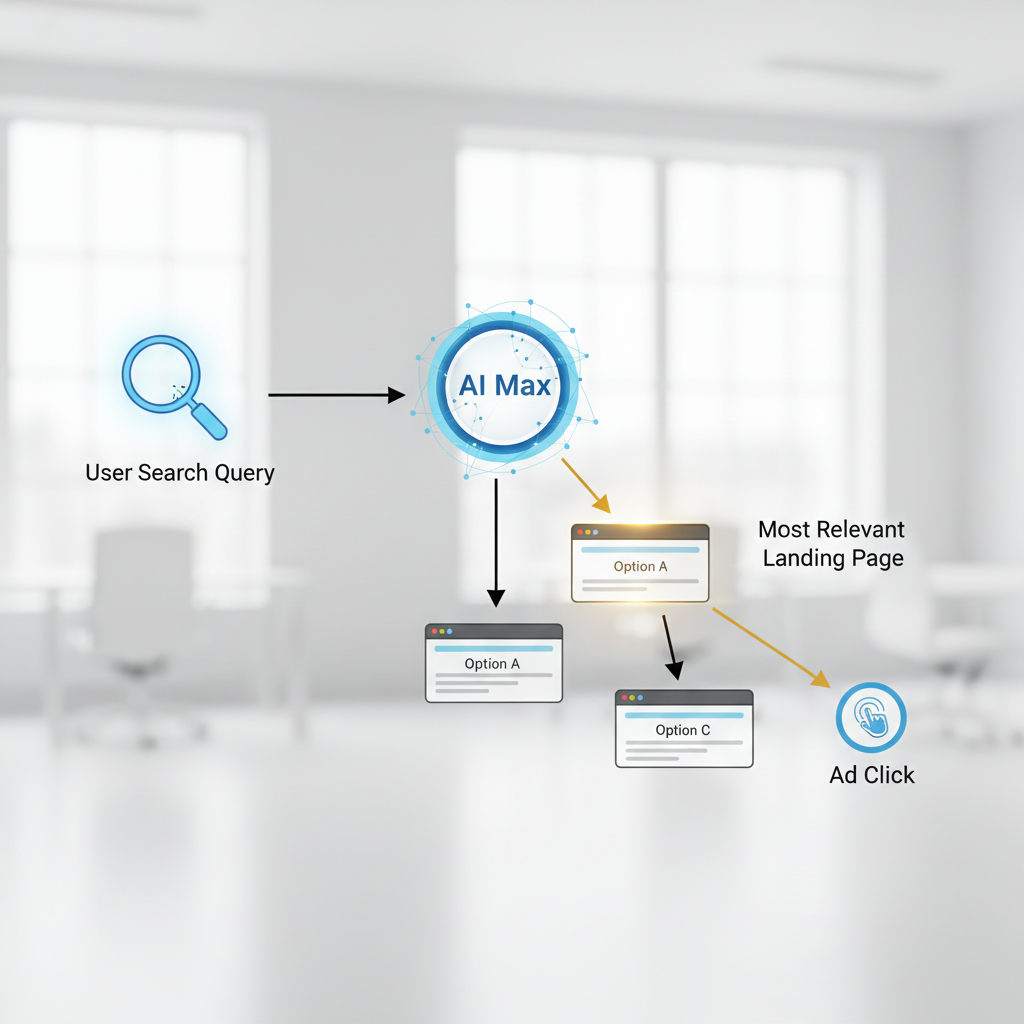
The core purpose of final URL expansion is to enhance ad relevance and effectiveness by ensuring a seamless user journey from search query to landing page. Without this feature, advertisers might inadvertently send traffic to generic pages, requiring users to navigate further to find what they need. By leveraging AI, Google can replace the designated final URL with a more appropriate page from your site, often resulting in improved click-through rates and conversions. This capability is particularly beneficial for large websites with extensive product catalogs or diverse content, where a single, manually assigned landing page might not always be the most effective choice for every possible search variation. It works in tandem with text customization, ensuring that the ad copy also dynamically aligns with the content of the chosen landing page.
What is the Role of AI in URL Selection?
The AI’s role in URL selection is to analyze real-time signals, user intent, and your website’s content to predict which page will offer the best user experience and conversion potential for a given search query. This goes beyond simple keyword matching. It considers the semantic meaning of the search, the content of various pages on your domain, and historical performance data to make an informed decision. The goal is to maximize the likelihood that a user finds exactly what they are looking for immediately upon clicking your ad.
How Does Final URL Expansion Differ from Traditional Landing Pages?
Traditional landing pages are static URLs explicitly set by the advertiser for an ad or ad group. With final URL expansion, the system can override this pre-set URL if its AI determines another page on your domain is more relevant to the user’s query. This offers greater flexibility and responsiveness to diverse search intents that might not be covered by a single, fixed landing page. It’s about optimizing for user intent at scale, rather than relying solely on manual assignments.
How AI Max Enhances Landing Page Control
AI Max landing page control empowers advertisers to balance the benefits of AI-driven automation with the necessity of maintaining brand safety and strategic direction. While AI Max final URL expansion can dynamically select the most relevant pages, advertisers retain significant control over which pages are eligible to serve. This is achieved through various URL controls, including inclusions and exclusions, which guide Google’s AI in its decision-making process. These controls are crucial for ensuring that ad traffic is directed to valuable, conversion-focused pages and away from irrelevant or non-commercial content. For more insights, check out our guide on Digital Marketing Services.

Advertisers can specify particular URLs or URL patterns that should never be used as landing pages, such as blog posts, “About Us” pages, or career sections, which typically do not lead to direct conversions. Conversely, they can also designate specific URLs or sections of their website that must be considered for ad serving, even if the AI might not initially prioritize them. This granular control ensures that while the AI optimizes for relevance, it operates within the advertiser’s predefined boundaries. This feature is particularly valuable for businesses with complex websites where certain pages are critical for specific campaign goals.
Managing URL Exclusions in AI Max
URL exclusions are a vital tool for preventing ads from landing on pages that are not designed for conversion or are otherwise inappropriate for paid traffic. You can add specific URLs or use rules (e.g., “URL contains /blog/”) to exclude entire sections of your website. This ensures that your ad spend is directed efficiently, avoiding pages that would lead to wasted clicks or a poor user experience. It’s recommended to regularly review your landing page reports to identify any undesirable pages receiving traffic and add them to your exclusion list.
Leveraging URL Inclusions for Targeted Traffic
URL inclusions allow you to explicitly tell AI Max to consider certain pages for ad serving. This can be particularly useful if you have new product pages, seasonal promotions, or specific landing pages that you want to ensure are prioritized by the AI. You can also use page feeds in conjunction with URL inclusions to provide a curated list of URLs for your campaign, acting as a strong signal for Google’s AI. By combining inclusions with the AI’s intelligence, you can achieve both broad reach and targeted precision.
Implementing AI Max URL Rules for Precision
Implementing AI Max URL rules provides advertisers with a sophisticated layer of control over the dynamic nature of final URL expansion. These rules, often referred to as “URL Contains” rules, allow you to define parameters based on specific text or patterns within your website’s URL strings. This capability is incredibly powerful for managing large websites or for campaigns that require precise targeting of specific content categories without manually listing every single URL. For example, an e-commerce business could create a rule to include all URLs containing “/shoes/” to ensure ads for footwear products always land on relevant shoe category or product pages. For more insights, check out our guide on Digital Marketing Services.
The strategic application of URL rules is essential for maximizing the effectiveness of AI Max while preventing unwanted traffic. Without proper rules, the AI might send users to pages that, while thematically related, are not optimized for conversion or do not align with the immediate goal of the ad. This precision helps maintain a high-quality user experience, which is paramount for ad performance. Furthermore, these rules can be applied at both the campaign and ad group levels, offering flexibility to tailor your landing page strategy to different segments of your advertising efforts.
Creating Effective URL Exclusion Rules
Effective URL exclusion rules are critical for budget efficiency and brand safety. Instead of listing individual URLs, you can create rules to block entire categories of pages. For instance, if your website has a blog section at “yourdomain.com/blog/”, you can create an exclusion rule for “URL contains /blog/” to prevent any blog posts from serving as ad landing pages. This is particularly useful for content that is informational rather than commercial. Regularly reviewing your search term and landing page reports can help identify common themes or sections of your site that should be excluded.
Setting Up URL Inclusion Rules for Specific Categories
URL inclusion rules allow you to guide AI Max towards specific, high-value sections of your website. For instance, a retailer might want to ensure that all ads related to “summer collection” products exclusively land on pages within the “/summer-collection/” path. By setting an inclusion rule, you reinforce the relevance of these pages to the AI, increasing the likelihood that they will be chosen for appropriate queries. This helps to consolidate traffic to your most important commercial pages, improving conversion rates.
Benefits of AI-Powered Search Ads Optimization
AI-powered search ads optimization, particularly through features like AI Max final URL expansion, offers a multitude of benefits for advertisers seeking to maximize their campaign ROI. The primary advantage lies in the ability to deliver more relevant ads to users, which directly translates to improved performance metrics. By dynamically matching ad creatives and landing pages to precise user intent, AI Max ensures that every click has a higher potential for conversion. This level of personalization and relevance is increasingly difficult to achieve manually, given the complexity and ever-evolving nature of user search queries.
Beyond relevance, AI Max contributes significantly to efficiency and scalability. Advertisers can expand their reach to new, relevant search queries that they might have missed with traditional keyword targeting alone. This “keywordless matching” capability, powered by advanced AI, identifies opportunities based on broader intent signals, allowing campaigns to capture a wider audience. Furthermore, the automation inherent in AI Max reduces the manual effort required for campaign management, freeing up valuable time for strategic planning and analysis. This means marketers can achieve better results with less time and less manual effort, driving overall campaign efficiency.
Here are key benefits of AI-powered search ads optimization:
* Improved Ad Relevance: AI Max dynamically generates ad headlines and descriptions that align with the chosen landing page and user query, making ads more personalized and relevant.
* Higher Conversion Potential: By directing users to the most appropriate landing page, AI Max increases the likelihood of conversions, as users find exactly what they need immediately.
* Expanded Reach: The AI identifies and targets new, relevant search queries beyond traditional keyword lists, uncovering untapped customer segments.
* Enhanced Efficiency: Automation reduces the need for constant manual adjustments, allowing advertisers to scale campaigns more effectively and focus on broader strategy.
* Better ROI: The combination of increased relevance, expanded reach, and operational efficiency ultimately leads to a higher return on ad spend.
Driving Higher Conversion Rates with AI Max
AI Max directly contributes to higher conversion rates by ensuring that users are presented with the most pertinent information as soon as they click an ad. When a user lands on a page that clearly addresses their query and offers a seamless path to conversion, they are far more likely to take the desired action, whether it’s a purchase, a sign-up, or a download. The AI’s ability to select the optimal page from your domain means fewer bounces and more engaged visitors.
Scaling Campaigns with Intelligent Automation
Intelligent automation through AI Max allows advertisers to scale their campaigns without a proportional increase in manual workload. The system can handle a vast array of search queries and dynamically adapt ad creatives and landing pages in real-time. This means businesses can effectively reach a broader audience and capitalize on emerging search trends without needing to create countless ad variations or constantly monitor and adjust individual URLs. It’s a powerful tool for growth and market expansion.
Best Practices for Optimizing with AI Max URL Expansion
To fully harness the power of AI Max URL expansion and achieve optimal campaign performance, advertisers should adopt a strategic approach that combines automation with careful oversight. Simply enabling the feature without proper management can lead to suboptimal results, as the AI might occasionally direct traffic to pages that, while relevant, are not ideal for conversion. The key is to treat final URL expansion as a sophisticated landing page automation tool, rather than just a reach expansion feature, understanding that page choice can significantly impact conversion outcomes.
One critical best practice is to ensure your website’s landing pages are well-optimized, clear, and distinct. AI Max relies on the quality and structure of your site’s content to make its routing decisions. Pages that are “thin,” lack clear commercial intent, or offer a poor user experience can lead the AI to make less effective routing choices, wasting ad spend. Therefore, investing in robust SEO and UX for all potential landing pages across your domain is paramount. This includes optimizing for Core Web Vitals, mobile-friendliness, and clear conversion pathways. Additionally, regular monitoring of landing page reports within Google Ads is essential to identify which URLs are receiving traffic and to fine-tune your inclusion and exclusion rules accordingly.
| Aspect | Traditional Final URL Management | AI Max Final URL Expansion |
|---|---|---|
| Landing Page Selection | Manually specified URL for each ad/ad group. | AI dynamically selects most relevant page from domain. |
| Relevance to Query | Relies on advertiser’s manual judgment. | AI matches page to precise user search intent in real-time. |
| Control Mechanism | Direct URL input. | URL inclusions, exclusions, and rules guide AI. |
| Scalability | Limited by manual effort for diverse queries. | High; AI handles dynamic routing for broad query range. |
| Website Quality Impact | Impacts only specified landing pages. | Impacts all potential landing pages on the domain. |
Auditing and Optimizing Your Website for AI Max
Before fully embracing AI Max final URL expansion, conduct a thorough audit of your website. Ensure that all category pages, service pages, and product pages are clear, distinct, and conversion-focused. Remove or improve any “thin” content, outdated promotional pages, or vague summaries that could confuse the AI. A well-structured website with deep, high-quality content provides the best foundation for AI Max to make intelligent routing decisions. Consider organizing content into “pillar pages” and content hubs for optimal AI understanding.
Continuous Monitoring and Refinement of URL Controls
Even with initial setup, continuous monitoring and refinement of your URL controls are crucial. Regularly check the landing page reports within Google Ads to see which pages AI Max is selecting and how they are performing. If you notice unwanted pages receiving traffic, promptly add them to your exclusion list. Conversely, if certain high-performing pages are not being utilized as much as desired, consider adding them to your inclusion list. This iterative process of monitoring, analyzing, and adjusting ensures that AI Max consistently aligns with your campaign objectives. For more insights into optimizing your digital marketing efforts, explore our Digital Marketing Services.
What is AI Max final URL expansion?
AI Max final URL expansion is a Google Ads feature that uses AI to dynamically select the most relevant landing page on your website for a user’s search query, even if it differs from the URL you initially provided.
How does AI Max landing page control work?
AI Max landing page control allows advertisers to guide the AI’s URL selection through inclusion and exclusion rules. This ensures that only appropriate and conversion-focused pages are used as landing destinations for ads.
Can I turn off AI Max final URL expansion?
Yes, AI Max final URL expansion is an opt-in setting within Google Ads campaigns. While it’s enabled by default when you opt into AI Max, you can choose to disable it in your campaign settings if it doesn’t align with your specific strategy.
What are AI Max URL rules?
AI Max URL rules are parameters (e.g., “URL contains /blog/”) that allow advertisers to include or exclude entire sections of their website from being used as ad landing pages. These rules provide granular control over the AI’s dynamic URL selection.
How does AI-powered search ads optimization improve performance?
AI-powered search ads optimization enhances performance by delivering more relevant ads and landing pages to users, expanding reach to new queries, and automating creative adjustments. This leads to higher click-through rates, better conversion rates, and improved ROI.
Is AI Max final URL expansion suitable for all businesses?
While beneficial for many, it’s most effective for businesses with well-structured websites and diverse content. Lead generation businesses or those with very specific landing page requirements might consider using URL exclusions or even disabling it until they validate its positive impact.
AI Max final URL expansion represents a significant leap in intelligent advertising, offering unparalleled opportunities for relevance and efficiency. By embracing this AI-powered feature, advertisers can:
* Boost ad relevance by automatically matching user intent with the most appropriate landing pages.
* Expand reach to discover new, high-converting customer segments through dynamic targeting.
* Optimize campaign performance by driving higher conversion rates and improving overall ROI.
* Streamline operations through intelligent automation, reducing manual effort in campaign management.
* Maintain control over landing page destinations using robust URL inclusion and exclusion rules.
As the digital landscape continues to evolve with AI at its core, mastering features like AI Max final URL expansion is not just an advantage—it’s a necessity. Advertisers who strategically integrate this technology into their campaigns will be well-positioned to unlock new levels of performance and stay competitive. Take the next step in your digital advertising journey by exploring how AI Max can transform your search campaigns.