

Vector SEO Content Structure for Modern Search
The vector SEO content structure is a sophisticated approach to organizing digital content, optimizing it for advanced search engine algorithms that leverage vector embeddings and semantic understanding. This strategy moves beyond traditional keyword matching, focusing instead on creating deeply relevant and contextually rich content that aligns with how AI-powered search engines interpret user intent. By adopting a vector-centric approach, marketers can significantly improve their content’s visibility and performance in an increasingly intelligent search landscape. Understanding this structure is crucial for any business aiming to thrive in the era of AI-driven search.
Understanding Vector Embeddings for SEO: How Search Engines Interpret Content Depth?
Vector embeddings for SEO involve converting words, phrases, and entire documents into numerical representations (vectors) in a multi-dimensional space, allowing search engines to understand the semantic relationships and contextual meaning of content rather than just keywords. This process enables search algorithms to match user queries with highly relevant content, even if the exact keywords are not present. For more insights, check out our guide on Digital Marketing Services.
In the realm of modern search, semantic embeddings SEO is fundamentally changing how content is valued and ranked. These numerical vectors capture the nuances of language, meaning that content isn’t just a collection of keywords; it’s a complex web of interconnected ideas. When a search engine processes a piece of content, it converts it into an embedding. Similarly, when a user types a query, that query is also converted into an embedding. The search engine then calculates the “distance” between these embeddings to determine relevance. Closer distances indicate higher semantic similarity and, therefore, greater relevance. This shift necessitates a deeper understanding of topic modeling and entity relationships within your content.

What are Semantic Embeddings and How Do They Impact Search Ranking?
Semantic embeddings are numerical representations of text that capture its meaning and context, allowing search engines to understand the relationships between words and concepts. These embeddings significantly impact search ranking by enabling algorithms to identify content that is conceptually similar to a user’s query, even if the exact keywords are not present. This means content that thoroughly covers a topic from multiple angles and demonstrates deep expertise will rank higher than content that merely stuffs keywords. The goal is to create content that aligns with the user’s intent, not just their literal search terms.
How Do Vector Databases Enhance Content Retrieval for Search Engines?
Vector databases are specialized systems designed to store and efficiently query these high-dimensional vector embeddings, making it faster and more scalable for search engines to retrieve semantically similar content. By indexing content as vectors, search engines can quickly find and present information that closely matches the conceptual meaning of a user’s query. This capability is crucial for delivering highly relevant results in real-time, especially as the volume and complexity of online information continue to grow. These databases are a core component of the infrastructure supporting advanced search capabilities.
Comparing Traditional Keyword Matching vs. Semantic Search Relevance
The evolution from traditional keyword matching to semantic search represents a significant leap in how search engines understand and deliver information.
| Feature | Traditional Keyword Matching | Semantic Search Relevance |
|---|---|---|
| Focus | Exact keyword presence | Meaning, context, and intent |
| Content Goal | Include target keywords frequently | Comprehensive topic coverage, entity relationships |
| Search Query Handling | Looks for literal word matches | Interprets user intent and related concepts |
| Ranking Factor | Keyword density, backlinks | Topical authority, contextual relevance, user engagement |
| Content Structure | Often siloed by keywords | Interconnected, holistic topic clusters |
This table illustrates the fundamental differences, highlighting why a vector SEO content structure is essential for contemporary content strategies.
Optimizing Content for AI Retrieval Systems: Strategies for Enhanced Visibility
Optimizing content for AI retrieval systems involves structuring and writing content in a way that makes it easily discoverable and understandable by artificial intelligence models used in search engines and large language models (LLMs). This means focusing on clarity, comprehensiveness, and the explicit definition of entities and relationships within your text. For more insights, check out our guide on Digital Marketing Services.
As AI models become increasingly central to search, content creators must adapt their strategies. AI retrieval systems don’t just scan for keywords; they analyze the entire document for its overall meaning, identifying key entities, attributes, and their relationships. For instance, if you write about “electric vehicles,” an AI system understands the connection to “batteries,” “charging infrastructure,” and “environmental impact” without explicit keyword stuffing. Therefore, your content should provide clear, unambiguous information that AI can easily parse and categorize. This includes using structured data where appropriate and ensuring logical flow throughout your articles. The goal is to make your content a reliable and easily digestible source of information for AI.
How to Structure Content for Better AI Understanding and Indexing?
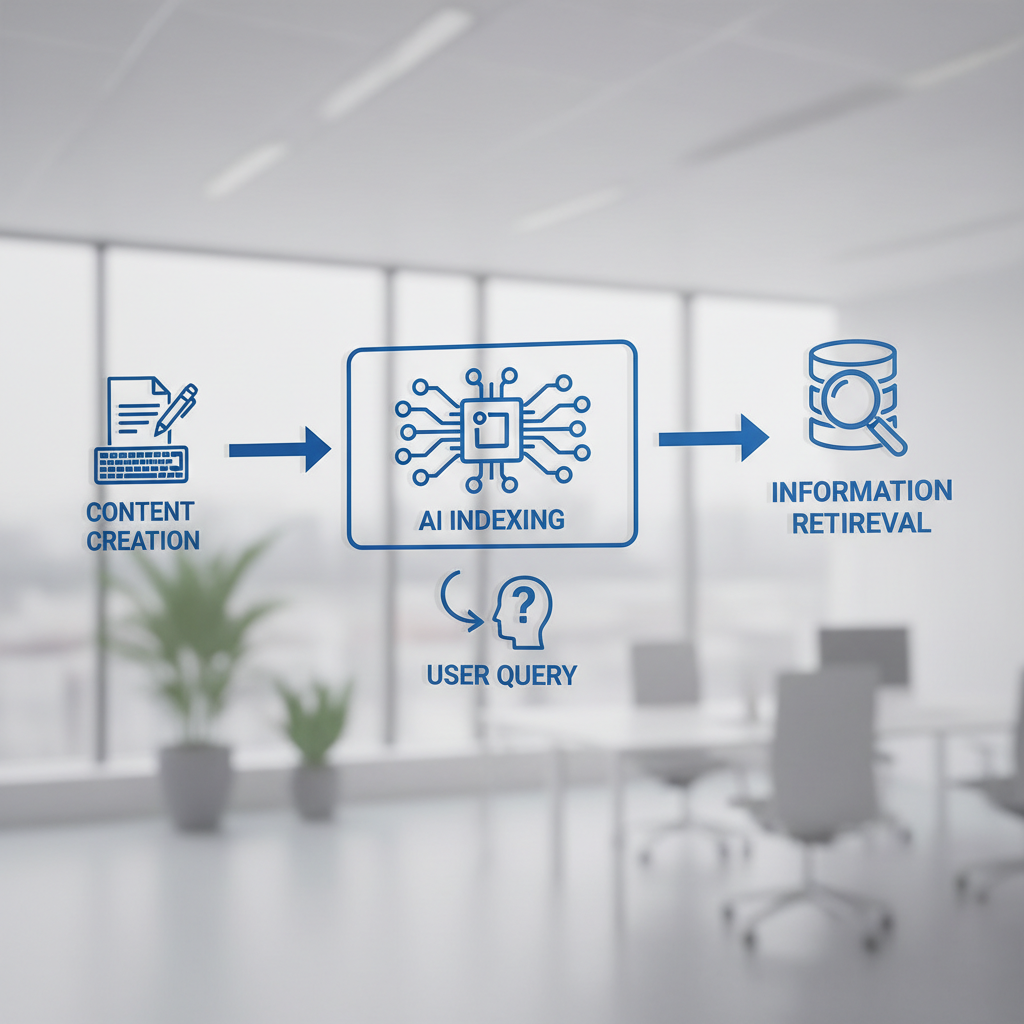
To structure content for better AI understanding and indexing, prioritize logical flow, clear headings, and explicit definitions of key terms and concepts. Use an outline that moves from general ideas to specific details, employing H1, H2, and H3 tags effectively to signal hierarchy. Incorporate internal links to related topics, creating a web of interconnected information that helps AI map your site’s topical authority. Additionally, ensure paragraphs are concise and focused, addressing one main idea at a time. This structured approach helps AI models quickly grasp the core subject matter and its various facets.
Leveraging Structured Data and Schema Markup for AI Retrieval
Leveraging structured data and schema markup is critical for optimizing content for AI retrieval. Schema markup provides explicit semantic tags that tell search engines and AI models exactly what specific pieces of information mean. For example, marking up an author, publication date, or product review helps AI understand the type of entity and its attributes. This clear, machine-readable context improves the accuracy of AI retrieval, making your content more likely to be featured in rich snippets, knowledge panels, and direct answers. Implementing relevant schema types, such as Article, FAQPage, or HowTo, can significantly boost your content’s visibility to AI systems.
Best Practices for Creating AI-Friendly Definitions and Explanations
Creating AI-friendly definitions and explanations involves being concise, accurate, and unambiguous. When defining a term, provide a clear, one-to-two sentence explanation at the beginning of its discussion. Use simple language and avoid jargon where possible. For complex topics, break down explanations into digestible chunks, using bullet points or numbered lists to improve readability. Ensure that your definitions are consistent throughout your content and across your website. This clarity helps AI models confidently extract and present your information as authoritative answers to user queries, fulfilling the promise of effective content for AI retrieval.
Implementing Vector Search Optimization Strategies: A Guide for Digital Marketers
Implementing vector search optimization strategies involves a multi-faceted approach to content creation and technical SEO, ensuring your digital assets are discoverable and highly relevant in search environments powered by vector embeddings. This goes beyond traditional keyword research, focusing on topical authority and semantic depth.
For digital marketers, understanding and applying vector search optimization is no longer optional; it’s a necessity. This paradigm shift requires a re-evaluation of how content is planned, created, and promoted. Instead of chasing individual keywords, the focus shifts to comprehensive topic coverage and building strong semantic networks within your content. This means conducting deep topic research to identify all related entities, concepts, and user intents surrounding a core subject. For example, if your core topic is “sustainable fashion,” your content should naturally cover related terms like “ethical sourcing,” “eco-friendly materials,” “circular economy,” and “fair trade practices.” By creating this rich, interconnected content, you increase the likelihood that your pages will be deemed highly relevant by vector search algorithms. Furthermore, technical SEO aspects, such as site architecture and internal linking, play an even more critical role in signaling these semantic relationships to search engines. For a deeper dive into how these next-gen strategies integrate with broader digital marketing efforts, consider exploring advanced Digital Marketing Services that specialize in AI-driven content.
Developing Topical Authority for Enhanced Vector Search Rankings
Developing topical authority is paramount for enhanced vector search optimization. Topical authority is established by consistently publishing comprehensive, high-quality content that thoroughly covers all aspects of a particular subject area. This involves creating a cluster of interconnected articles, guides, and resources that address various user intents related to your core topic. For example, a website aiming for authority in “digital marketing” would have content on SEO, PPC, social media, content marketing, email marketing, and their sub-topics. This holistic approach signals to vector search algorithms that your site is a definitive source of information, leading to higher rankings for a broad range of related queries.
The Role of Internal Linking in Building Semantic Networks for Vector Search
Internal linking plays a crucial role in building semantic networks that benefit vector search optimization. By strategically linking related articles within your website, you create a clear roadmap for both users and search engine crawlers, highlighting the relationships between different pieces of content. These internal links help search engines understand the breadth and depth of your topical coverage, reinforcing your authority on a subject. When executed correctly, internal linking helps to distribute “link equity” and signals to vector search algorithms that your content forms a cohesive, authoritative cluster of information, improving its overall discoverability and relevance.
Utilizing Entity-Based SEO for Superior Vector Search Results
Utilizing entity-based SEO is a superior strategy for achieving better vector search optimization results. Entity-based SEO focuses on identifying and optimizing for real-world “things” or concepts (entities) rather than just keywords. This involves ensuring that your content clearly defines, describes, and links to relevant entities, making it easier for search engines to understand the relationships between them. For instance, if writing about “ChatGPT,” you would explicitly mention “OpenAI,” “large language model,” “natural language processing,” and “generative AI” as related entities. This rich, entity-centric approach helps search engines build a more accurate knowledge graph of your content, leading to more precise and relevant retrieval in vector search environments.
Crafting Semantic Embeddings SEO Content: From Keywords to Concepts
Crafting semantic embeddings SEO content involves a fundamental shift from keyword-centric writing to concept-centric writing, where the goal is to thoroughly cover a topic’s entire semantic field rather than just repeating target keywords. This approach ensures your content resonates with advanced search algorithms that prioritize meaning and context. For more insights, check out our guide on Digital Marketing Services.
The transition to creating content optimized for semantic embeddings requires a strategic change in how we approach content creation. Instead of merely identifying high-volume keywords and writing articles around them, the focus now is on understanding the overarching concepts, user intents, and related entities that constitute a topic. This means conducting comprehensive topic research that uncovers the questions users ask, the problems they try to solve, and the broader context surrounding their queries. For example, if your target concept is “sustainable living,” your content should naturally delve into sub-concepts like “zero-waste,” “renewable energy,” “eco-friendly products,” and “minimalism.” By building out this rich conceptual network within your articles, you create content that search engines, powered by semantic embeddings, can easily understand and deem highly relevant for a wide array of related searches. This depth and breadth of coverage are what drive true topical authority in the modern search landscape.
How to Conduct Concept-Based Keyword Research for Semantic SEO?
To conduct concept-based keyword research for semantic embeddings SEO, begin by identifying your core topic and then brainstorm all related sub-topics, entities, and questions users might ask. Utilize tools that provide “people also ask” sections, topic clusters, and semantic keyword suggestions rather than just exact match keywords. Focus on understanding the intent behind potential queries. Create a mind map or a hierarchical list of concepts, ensuring you cover the breadth and depth of the subject. This approach helps you identify the entire semantic field of a topic, allowing you to create comprehensive content that satisfies diverse user intents and aligns with how AI understands information.
Integrating Latent Semantic Indexing (LSI) Keywords for Deeper Context
Integrating Latent Semantic Indexing (LSI) keywords is a valuable technique for adding deeper context to your semantic embeddings SEO content. LSI keywords are terms and phrases that are semantically related to your main topic but are not direct synonyms. For instance, if your main topic is “coffee,” LSI keywords might include “espresso machine,” “barista,” “caffeine,” “roasting beans,” or “brew methods.” By naturally incorporating these related terms, you signal to search engines that your content provides comprehensive coverage of the subject. This helps AI models understand the full context of your article, improving its chances of ranking for a wider range of semantically related queries and demonstrating topical expertise.
Writing for Topic Clusters and Pillar Pages in a Semantic World
Writing for topic clusters and pillar pages is a foundational strategy in a semantic world, essential for semantic embeddings SEO. A pillar page broadly covers a core topic, while topic clusters consist of several supporting articles that delve into specific sub-topics in detail, all linked back to the pillar page. This structure creates a clear semantic network, signaling to search engines the depth of your expertise on a subject. By organizing your content this way, you help search engines understand the relationships between different pieces of information, enhancing your overall topical authority and improving the discoverability of all related content through semantic understanding.
RAG SEO for Marketers: Building Retrieval-Augmented Generation Content
RAG SEO for marketers involves creating content specifically designed to be effectively retrieved and utilized by Retrieval-Augmented Generation (RAG) models, which combine information retrieval with large language model generation to provide highly accurate and contextually rich answers. This means structuring content for explicit factual extraction and clear contextual understanding.
For marketers, understanding RAG SEO is becoming increasingly vital as AI-powered search and conversational interfaces become more prevalent. RAG models work by first retrieving relevant information from a vast knowledge base (like the internet or a specific dataset) and then using that information to generate a coherent and accurate response. Therefore, your content needs to be not only comprehensive but also highly scannable and factually precise. This means clearly stating facts, defining terms, and providing structured answers to common questions. Think about how your content would serve as a reliable source for an AI trying to answer a user’s query. By making your content easily retrievable and extractable by these models, you increase its chances of being cited or directly used in AI-generated responses, which translates to enhanced visibility and authority. This new approach requires a focus on clarity, accuracy, and a logical presentation of information.
What is Retrieval-Augmented Generation (RAG) and Its SEO Implications?
Retrieval-Augmented Generation (RAG) is an AI framework that enhances large language models by allowing them to retrieve information from external knowledge sources before generating a response. For SEO, this implies that content needs to be easily identifiable and extractable by these retrieval mechanisms. Content that is well-structured, factually accurate, and provides clear answers to specific questions will be more likely to be retrieved and used by RAG models, leading to increased visibility in AI-driven search results and potentially being directly cited as a source. This makes RAG SEO for marketers a critical new frontier.
Crafting Content Snippets for AI-Powered Answer Boxes and Summaries
Crafting content snippets for AI-powered answer boxes and summaries requires conciseness, directness, and accuracy. For each key question or concept, provide a clear, one-to-two sentence direct answer early in the relevant section. Use strong topic sentences and ensure that your paragraphs are self-contained, meaning they can be understood even when extracted out of context. Employ lists and tables to present information in an easily digestible format. The goal is to make it effortless for AI models to extract the most pertinent information, increasing the likelihood of your content appearing in featured snippets, direct answers, or AI-generated summaries, a core component of RAG SEO for marketers.
Optimizing for Conversational Search and Voice Assistants with RAG Principles
Optimizing for conversational search and voice assistants using RAG principles means creating content that directly answers natural language questions. Voice queries are often more conversational and question-based than typed searches. Therefore, your content should anticipate these questions and provide clear, concise answers, often in a Q&A format. Structure your content to mimic natural dialogue, using headings that pose questions and paragraphs that provide direct answers. By aligning your content with the way people speak and ask questions, you make it highly suitable for retrieval by RAG models, which in turn improves its performance in conversational search and voice assistant results, a key aspect of RAG SEO for marketers.
Measuring and Iterating on Vector SEO Performance: Analytics and Adaptations
Measuring and iterating on vector SEO content structure performance requires moving beyond traditional keyword rankings to analyze broader metrics like topical authority, semantic relevance, and AI retrieval success. This involves using advanced analytics to understand how effectively your content is meeting user intent and being understood by modern search algorithms.
In the evolving landscape of search, simply tracking keyword positions no longer provides a complete picture of your content’s effectiveness. With vector search and AI retrieval, the focus shifts to how well your content covers a topic comprehensively and how frequently it’s being deemed relevant for a wide range of semantically related queries. This necessitates a more sophisticated approach to analytics. Marketers should look at metrics such as overall topic visibility, the diversity of queries a page ranks for, and engagement signals that indicate user satisfaction and content depth. Tools that can analyze semantic similarity and topic cluster performance become invaluable. By continuously monitoring these advanced metrics, you can identify areas where your vector SEO content structure can be improved, allowing for ongoing optimization and adaptation to algorithm changes. This iterative process ensures your content remains competitive and highly visible in an AI-driven search environment.
Key Performance Indicators (KPIs) for Vector SEO Success
Key Performance Indicators (KPIs) for vector SEO content structure success extend beyond basic keyword rankings. Important metrics include:
* Topical Authority Score: A measure of your website’s comprehensive coverage and expertise on a given subject.
* Semantic Relevance Score: How closely your content’s meaning aligns with a broad range of related user queries.
* Featured Snippet and Direct Answer Impressions: Tracking how often your content appears in AI-powered answer boxes.
* Query Diversity: The number of unique, semantically related queries a single page ranks for.
* User Engagement Metrics: Time on page, bounce rate, and click-through rate, indicating content quality and relevance.
* Internal Link Equity Flow: Analyzing how well link value is distributed across your topic clusters.
Monitoring these KPIs provides a holistic view of your vector SEO performance.
Using Analytics to Identify Gaps in Semantic Coverage and Topical Authority
Using analytics to identify gaps in semantic coverage and topical authority involves a deep dive into your content’s performance across a spectrum of related queries. Tools that map keyword clusters and identify missing sub-topics can highlight areas where your content lacks depth. By analyzing which semantically related queries your content isn’t ranking for, you can pinpoint specific gaps in your vector SEO content structure. Furthermore, examining user behavior metrics like time on page for certain topics can reveal where content might be superficial or fail to fully satisfy user intent. This analytical feedback loop is crucial for continuously refining your content strategy and building stronger topical authority.
Adapting Content Strategies to Evolving AI Search Algorithms
Adapting content strategies to evolving AI search algorithms requires continuous learning and flexibility. Stay informed about updates in natural language processing (NLP) and machine learning models used by search engines. Regularly audit your content for semantic depth, clarity, and factual accuracy, ensuring it aligns with the principles of vector search optimization and content for AI retrieval. Experiment with new content formats that cater to AI, such as structured Q&A sections and comprehensive definitions. The key is to view your content as a dynamic asset that needs constant refinement to maintain relevance and visibility in an ever-changing AI-driven search landscape.
What is vector SEO content structure?
Vector SEO content structure refers to organizing content to optimize for modern search engines that use vector embeddings to understand semantic meaning and context, moving beyond simple keyword matching. It focuses on creating comprehensive, interconnected content that addresses user intent broadly.
How do semantic embeddings help SEO?
Semantic embeddings help SEO by converting text into numerical vectors that capture meaning, allowing search engines to identify content that is conceptually relevant to a user’s query, even without exact keyword matches. This leads to more accurate and contextually rich search results.
Why is content for AI retrieval important?
Content for AI retrieval is important because search engines increasingly use AI models to understand, index, and present information. Optimizing for AI retrieval ensures your content is easily discoverable, understandable, and usable by these systems, increasing its chances of appearing in featured snippets and direct answers.
What is vector search optimization?
Vector search optimization is the process of preparing content to perform well in search environments that utilize vector databases and embeddings for relevance ranking. It involves creating topically authoritative and semantically rich content that aligns with how AI understands and retrieves information.
How does RAG SEO benefit marketers?
RAG SEO benefits marketers by guiding the creation of content that can be effectively retrieved and used by Retrieval-Augmented Generation (RAG) models. This increases the likelihood of content being cited or directly used in AI-generated responses, enhancing visibility and establishing authority in AI-driven search.
What is the difference between keyword matching and semantic search?
Keyword matching focuses on the literal presence of keywords in content, while semantic search interprets the meaning, context, and intent behind a user’s query and the content itself. Semantic search uses advanced AI to understand conceptual relationships, providing more relevant results than simple keyword matching.
How can I measure the success of my vector SEO strategy?
Measure vector SEO success by tracking KPIs like topical authority score, semantic relevance score, featured snippet impressions, query diversity, and user engagement metrics. These indicators provide a more comprehensive view of your content’s performance in AI-driven search environments.
The shift towards a vector SEO content structure marks a pivotal moment in digital marketing, demanding a more sophisticated approach to content creation. By embracing semantic understanding and optimizing for AI retrieval, marketers can future-proof their strategies.
Key takeaways for navigating this new era:
* Prioritize Semantic Depth: Move beyond keywords to comprehensive topic coverage and conceptual understanding.
* Structure for AI: Organize content logically with clear definitions and structured data for easy AI parsing.
* Build Topical Authority: Create interconnected content clusters that establish your expertise on a subject.
* Optimize for RAG: Craft content that is easily retrievable and usable by AI generation models for answers.
* Iterate with Advanced Analytics: Track metrics beyond keyword rankings to understand true semantic performance.
Embracing these principles will not only improve your content’s visibility in current search environments but also prepare it for the continued evolution of AI-powered search. Start refining your content strategy today to unlock new levels of relevance and discoverability.