

Marketing Automation With AI Agents Strategy For Lean Teams 2026
The landscape of digital marketing is rapidly evolving, making marketing automation with AI agents a critical strategy for businesses looking to maximize efficiency and impact, especially for lean teams. AI agents are transforming how marketing operations function, enabling smaller teams to achieve results typically associated with larger departments by automating complex, end-to-end workflows. This article explores how lean teams can strategically implement AI agents to streamline processes, enhance productivity, and drive measurable growth without extensive resources.
Automating End-to-End Marketing Workflows with AI Agents
Automating end-to-end marketing workflows with AI agents involves deploying intelligent software entities to autonomously manage and execute various marketing tasks from inception to completion. This approach significantly reduces manual effort, accelerates campaign delivery, and ensures consistency across all marketing touchpoints. For lean teams, this means the ability to scale operations and tackle complex projects without needing to expand headcount.
What are AI Agents in Marketing Automation?
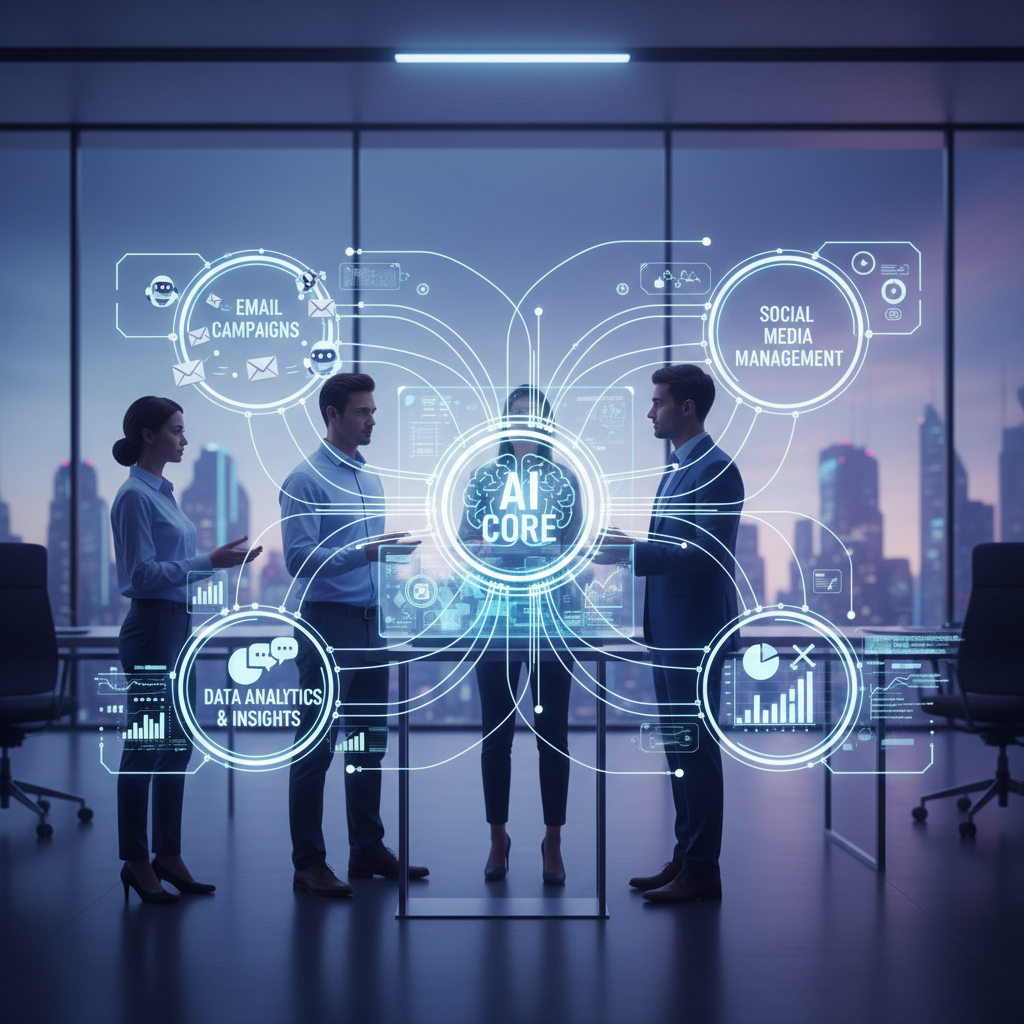
AI agents in marketing automation are sophisticated software programs designed to perform specific tasks, make decisions, and interact with other systems autonomously. These agents can analyze data, generate content, schedule posts, respond to customer inquiries, and optimize campaigns based on predefined rules and learned patterns. They act as virtual team members, handling repetitive or data-intensive activities, freeing human marketers to focus on strategy and creativity. Implementing AI agents allows lean teams to expand their operational capacity significantly.
How to Automate End-to-End Marketing Workflows with AI Agents Effectively
To effectively automate end-to-end marketing workflows, lean teams should start by identifying repetitive, rule-based tasks that consume significant time. These often include lead nurturing sequences, content distribution, social media scheduling, and basic customer support interactions. By mapping out these processes, teams can design AI agent workflows that seamlessly integrate different tools and platforms. The goal is to create a continuous, self-optimizing loop where agents handle execution, allowing human oversight for strategic adjustments and performance monitoring.
Benefits of End-to-End Automation for Lean Marketing Teams
The primary benefit for lean marketing teams is a dramatic increase in operational efficiency and output. AI agents enable 24/7 operations, ensuring tasks are completed promptly and consistently, even outside business hours. This leads to faster campaign execution, improved lead response times, and enhanced customer engagement. Furthermore, by reducing the burden of manual tasks, team members can dedicate more time to high-value activities such as strategic planning, creative development, and in-depth performance analysis. This shift in focus is crucial for driving innovation and maintaining a competitive edge.
Leveraging N8N and Zapier AI Automation for Marketing Operations
N8N and Zapier are powerful no-code/low-code platforms that enable lean marketing teams to integrate AI agents and automate complex workflows without extensive programming knowledge. These tools act as the central nervous system for your marketing operations, connecting various applications and allowing AI agents to orchestrate tasks across different platforms. They democratize access to advanced automation, making sophisticated strategies achievable for teams with limited technical resources.
Integrating AI Agents with N8N for Enhanced Flexibility
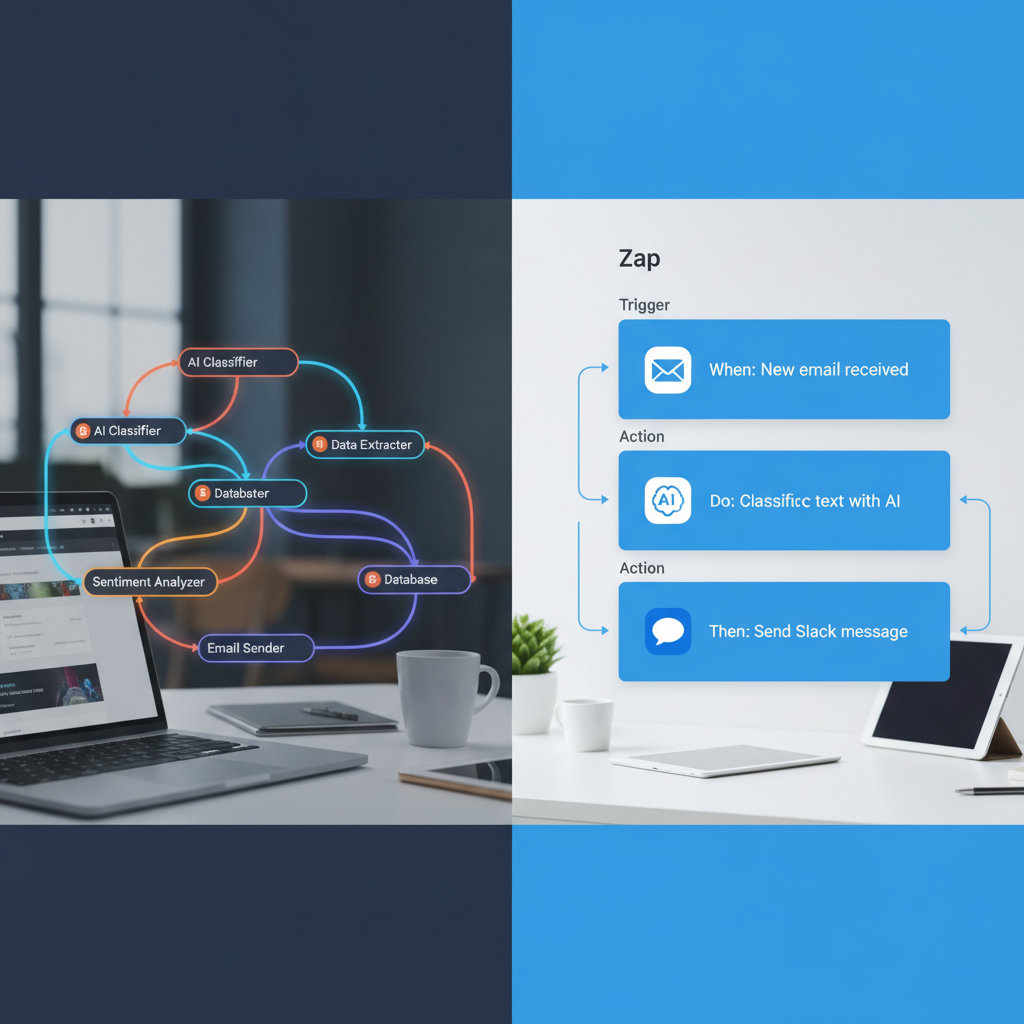
N8N offers a highly flexible and extensible platform for building custom automation workflows. Its self-hosted option provides greater control over data and privacy, which can be a significant advantage for lean teams dealing with sensitive marketing data. With N8N, you can connect AI agents to a wide array of services, from CRM systems and email marketing platforms to social media channels and data analytics tools. This allows for intricate, multi-step automations where AI agents can trigger actions, process information, and update records across your entire marketing stack. For instance, an AI agent could analyze website visitor behavior, then trigger an N8N workflow to segment that user and initiate a personalized email sequence.
Using Zapier for Quick and Accessible AI Automation Strategy
Zapier is renowned for its user-friendly interface and vast library of integrations, making it an excellent choice for lean teams looking to quickly implement an AI automation strategy. Its intuitive “Zaps” allow you to connect AI-powered tools with hundreds of other applications, creating automated workflows with minimal setup. For example, an AI agent could generate social media post ideas, and Zapier could then automatically schedule those posts across various platforms. The ease of use means that even team members without deep technical skills can contribute to building and maintaining automated processes. This accessibility is key for maximizing the impact of AI on marketing operations within a small team.
Comparative Analysis: N8N vs. Zapier for Marketing Automation
Choosing between N8N and Zapier depends on specific team needs and technical comfort levels. Both platforms are excellent for integrating AI agents into marketing workflows, but they cater to slightly different requirements.
| Feature | N8N | Zapier |
|---|---|---|
| Ease of Use | Moderate (more visual programming) | High (intuitive, guided setup) |
| Customization & Flexibility | High (self-hosted, custom code options) | Moderate (relies on pre-built integrations) |
| Integrations | Extensive (community nodes, custom webhooks) | Very Extensive (thousands of apps) |
| Pricing Model | Open-source (self-hosted free), cloud plans | Subscription-based (tiered) |
| Ideal For | Teams needing deep customization, data control | Teams prioritizing speed, simplicity, broad integrations |
For teams seeking more control and willing to invest a bit more time in setup, N8N offers unparalleled flexibility. However, for those prioritizing rapid deployment and ease of use, Zapier provides a robust and accessible solution for integrating AI agents into existing workflows. Both are invaluable for implementing an effective N8N and Zapier AI automation strategy for marketing operations. For more advanced automation capabilities and strategic planning, consider exploring comprehensive Digital Marketing Services that specialize in integrating these tools.
Designing AI Agent Workflows for Content Publishing and Social Media Management
Designing effective AI agent workflow for content publishing and social media management involves leveraging AI to automate content creation, scheduling, distribution, and engagement tasks, significantly boosting output and consistency for lean teams. These workflows allow AI agents to handle the heavy lifting of content operations, from generating initial drafts to optimizing posting times and interacting with audiences. This frees up human marketers to focus on strategic content planning, creative oversight, and deeper audience engagement. For more insights, check out our guide on Digital Marketing Services.
Automating Content Generation and Curation with AI Agents
AI agents can revolutionize content creation by assisting with idea generation, drafting articles, and curating relevant information. For instance, an AI agent can analyze trending topics in your industry, generate blog post outlines, or even write initial drafts based on specific keywords and style guidelines. Beyond creation, AI agents excel at content curation, sifting through vast amounts of online data to identify relevant articles, news, and insights that can be shared with your audience. This capability ensures a consistent flow of fresh, engaging content without requiring extensive manual research or writing from your lean team.
Streamlining Social Media Management with AI-Powered Scheduling and Engagement
Social media management often consumes a significant portion of a marketing team’s time. An AI agent workflow for content publishing and social media management can automate many of these tasks. AI agents can analyze audience demographics and engagement patterns to determine the optimal times for posting content across various platforms. They can also assist with drafting social media captions, generating relevant hashtags, and even personalizing responses to comments and direct messages. This not only ensures timely and consistent social media presence but also enhances audience engagement by providing prompt and tailored interactions.
Implementing AI for Content Distribution and Performance Optimization
Beyond creation and scheduling, AI agents can play a crucial role in content distribution and performance optimization. An AI agent can analyze which platforms yield the best results for specific content types and then automatically distribute content accordingly. For example, an agent might identify that long-form articles perform better on LinkedIn, while short-form videos thrive on Instagram. Furthermore, AI can monitor content performance in real-time, identifying underperforming pieces and suggesting optimizations, such as headline changes, image adjustments, or different distribution channels. This continuous optimization loop ensures that your content consistently reaches the right audience and achieves its desired impact.
Optimizing Customer Journeys with AI-Driven Personalization and Segmentation
Optimizing customer journeys with AI-driven personalization and segmentation allows lean marketing teams to deliver highly relevant and timely experiences to individual customers, significantly enhancing engagement and conversion rates. AI agents analyze vast amounts of customer data to understand individual preferences, behaviors, and needs, enabling marketers to tailor every interaction for maximum impact. This level of personalization, once resource-intensive, is now accessible to smaller teams through intelligent automation.
Leveraging AI for Dynamic Customer Segmentation
Traditional customer segmentation often relies on broad demographic data, which can be limiting. AI agents can perform dynamic customer segmentation by analyzing real-time behavioral data, purchase history, engagement patterns, and even sentiment analysis from interactions. This allows for the creation of micro-segments that are far more precise and responsive to changing customer needs. For example, an AI agent can identify customers who have recently viewed a specific product category multiple times but haven’t purchased, automatically placing them into a “high-intent” segment for a targeted follow-up. This granular approach ensures that marketing messages are always relevant.
Personalizing Customer Interactions Across All Touchpoints
AI agents enable hyper-personalization across every stage of the customer journey, from initial awareness to post-purchase support. This includes personalizing website content, email campaigns, ad creatives, and even chatbot interactions. An AI agent can dynamically adjust website recommendations based on browsing history, craft email subject lines that resonate with individual preferences, and ensure that chatbots provide context-aware responses. This seamless and personalized experience fosters stronger customer relationships and significantly improves the likelihood of conversion and repeat business. For lean teams, this means delivering a premium, tailored experience without the need for extensive manual customization.
Predictive Analytics and Proactive Engagement with AI Agents
One of the most powerful applications of AI in optimizing customer journeys is its ability to perform predictive analytics. AI agents can analyze historical data to forecast future customer behavior, such as predicting churn risk, identifying potential upsell opportunities, or anticipating future needs. This allows lean teams to engage proactively with customers, addressing potential issues before they arise or offering relevant solutions at precisely the right moment. For example, an AI agent might predict that a customer is likely to cancel their subscription and trigger a personalized retention offer. This proactive approach not only improves customer satisfaction but also drives long-term customer lifetime value.
Marketing Operations AI Automation ROI Measurement Guide
Measuring the ROI of marketing operations AI automation is crucial for lean teams to justify investments, optimize strategies, and demonstrate tangible business value. A comprehensive marketing operations AI automation ROI measurement guide helps teams track key performance indicators (KPIs) that reflect efficiency gains, cost savings, and revenue growth directly attributable to AI agent implementation. This systematic approach ensures that AI automation efforts are aligned with business objectives and deliver a clear return.
Defining Key Performance Indicators (KPIs) for AI Automation
To accurately measure ROI, lean teams must first define relevant KPIs. These should directly relate to the goals of their AI automation strategy. Common KPIs include:
* Time Savings: Hours saved on repetitive tasks (e.g., content scheduling, data entry, lead qualification).
* Cost Reduction: Decreased operational costs due to automation (e.g., reduced need for manual labor, lower ad spend through optimization).
* Conversion Rate Improvement: Higher lead-to-customer conversion rates through personalized nurturing.
* Lead Quality: Improved lead scoring and qualification by AI agents.
* Customer Engagement: Increased open rates, click-through rates, and social media interactions.
* Content Output: Quantity and quality of content produced or curated by AI agents.
By tracking these metrics, teams can quantify the direct impact of AI on their marketing performance.
Calculating the Financial Impact of AI Agent Implementation
Calculating the financial impact involves translating the defined KPIs into monetary terms. For example, time savings can be converted into labor cost savings by multiplying saved hours by the average hourly wage of the team members previously performing those tasks. Increased conversion rates can be directly linked to additional revenue generated. Reduced ad spend due to AI-driven optimization also contributes to cost savings. It’s important to consider both direct cost savings and revenue uplift when calculating ROI. A simple formula for ROI is:
$$ROI = \frac{(Gain from Investment – Cost of Investment)}{Cost of Investment} \times 100\%$$
This provides a clear percentage return on the investment in AI tools and agents.
Continuous Optimization and Reporting for AI Automation ROI
ROI measurement should not be a one-time activity but an ongoing process. Lean teams should regularly monitor their KPIs, analyze the performance of their AI agents, and make data-driven adjustments to their automation workflows. This continuous optimization ensures that the AI automation strategy remains effective and continues to deliver maximum value. Regular reporting, perhaps monthly or quarterly, allows teams to communicate the value of AI to stakeholders, secure further investment, and refine their approach. This systematic review is a vital part of any effective marketing operations AI automation ROI measurement guide.
What are AI agents in marketing?
AI agents in marketing are autonomous software programs that perform specific marketing tasks, make decisions, and interact with other systems. They can analyze data, generate content, manage social media, and personalize customer interactions, acting as virtual team members to enhance efficiency and scale operations.
How can lean teams use AI for marketing automation?
Lean teams can use AI for marketing automation by identifying repetitive tasks, deploying AI agents to handle them, and integrating these agents with platforms like N8N or Zapier. This allows for automated content creation, social media management, lead nurturing, and personalized customer journeys, maximizing output with limited resources.
What is an N8N and Zapier AI automation strategy?
An N8N and Zapier AI automation strategy involves using these no-code/low-code platforms to connect AI agents with various marketing tools. N8N offers flexibility for complex, custom workflows, while Zapier provides ease of use for quick integrations, enabling seamless data flow and task orchestration across different applications for enhanced marketing operations.
How do AI agents help with content publishing?
AI agents help with content publishing by automating tasks like idea generation, drafting content outlines, writing initial drafts, curating relevant information, and optimizing content for search engines. They can also assist with scheduling posts and distributing content across various platforms, ensuring consistent and timely delivery.
Can AI agents manage social media effectively?
Yes, AI agents can effectively manage social media by automating scheduling, drafting captions, generating relevant hashtags, and personalizing responses to comments and messages. They analyze audience data to determine optimal posting times and enhance engagement, freeing up human marketers for strategic interaction.
How do you measure the ROI of marketing automation with AI?
Measuring ROI involves defining KPIs such as time savings, cost reduction, conversion rate improvements, and increased customer engagement. These are then translated into financial gains and compared against the cost of AI tools and implementation. Continuous monitoring and reporting are essential for optimizing strategies and demonstrating value.
Implementing marketing automation with AI agents is no longer a luxury but a necessity for lean teams aiming for efficiency and growth. By strategically integrating AI into marketing operations, even small teams can achieve remarkable results.
Key takeaways for lean teams:
* Embrace End-to-End Automation: Identify and automate repetitive marketing workflows from start to finish using AI agents.
* Leverage Integration Platforms: Utilize tools like N8N and Zapier to seamlessly connect AI agents with your existing marketing stack.
* Streamline Content & Social: Design AI agent workflows for efficient content generation, publishing, and social media management.
* Prioritize Personalization: Use AI for dynamic customer segmentation and hyper-personalized interactions across all touchpoints.
* Measure and Optimize: Establish clear KPIs and continuously measure the ROI of your AI automation efforts to ensure ongoing value.
By adopting these strategies, lean teams can transform their marketing capabilities, driving significant improvements in productivity, engagement, and ultimately, business growth. Start exploring how AI agents can empower your team to do more with less, and unlock new levels of marketing excellence.